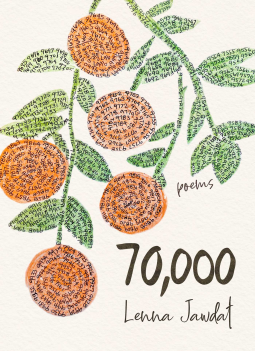
70,000
Poems
This title was previously available on NetGalley and is now archived.
Send NetGalley books directly to your Kindle or Kindle app
1
To read on a Kindle or Kindle app, please add kindle@netgalley.com as an approved email address to receive files in your Amazon account. Click here for step-by-step instructions.
2
Also find your Kindle email address within your Amazon account, and enter it here.
Pub Date Jul 7 2026 | Archive Date Jul 1 2026
Central Avenue Publishing | Central Avenue Poetry
Talking about this book? Use #70000 #NetGalley. More hashtag tips!
Description
70,000 is a visceral and inventive poetry collection inspired by the removal of approximately 70,000 books from Palestinian homes and private libraries before and during the events of 1948. Of those books, most have not been returned; about 6,000 remain housed in Israeli national collections, where they are largely inaccessible to Palestinians.
In response to this loss of cultural and intellectual heritage, Lenna Jawdat began handwriting the numbers one to 70,000, choosing to imagine each number as a book. Trained as a trauma therapist, she documented the emotional and physical experience of this ritual, tracing the grief, reverence, and endurance that surfaced through the process. This full-color book unfolds through three interwoven threads: the numbers themselves, reflections on the act of writing, and a personal and familial poetic narrative expressed in both image and verse. Together, they form a fragmented yet powerful archive—blending poetry, memoir, maps, documents, and collage.
70,000 is an embodied meditation on cultural displacement, memory, and resilience. What begins as a personal act of witnessing becomes a collective gesture toward remembrance, continuity, and the possibility of healing.
Advance Praise
“A precious poetess of Palestinian descent excavates the archeology of loss and erasure with a creative cri de coeur, meticulously researched and illustrated. She distills striking historical landmarks into a poignant tableau of pain. Lenna Jawdat mines cultural symbols that sustain overlooked Palestinian identity and roots, weaving them into a novel format, breaking the wounds of invisibility and suppressed slights wide open. Now that the world is watching, this is a tender, honest and unique gem of a book.” — Nora Boustany, former Middle East Washington Post correspondent and columnist
“Lenna Jawdat’s generous hybrid collection is part diary, part historical record, part ritual, and all ode. I feel deep gratitude for this love-act. Through her meditation Jawdat undertakes a transformative and laborious accounting which poses rippling questions: On stolen land, who counts? Who might never be accounted for? In the face of mammoth loss—of a people, of stories, of home—Jawdat chooses the powerful combination of ink and vulnerability. Slowly, steadfastly, she lays bare her inherited trauma alongside her “inherited resilience,” making legible what’s been invisibilized, vowing “I will document them somehow / Each number a tombstone / Something to return to.” Long after I’m done reading, I feel the reverberations of her hajj. Her markings evoke not just a graveyard, but a body returning to what it loves.” — Shira Erlichman, author of Odes to Lithium
“What is the legacy of diaspora? How does one cure homesickness without recourse to home? How do we continue to live with our grief even as the causes of our grief are ongoing? “Sometimes the things we are witnessing are too much to bear,” Jawdat writes. And yet, we go on because we must, because we can, through the community we carry with us, that history would erase. That is the work of the poet: to remember the humanity behind the history too easily corrupted, and to remember the worlds lived and dreamed. To remind us all that if we inherit trauma in the body, we also inherit resilience, and we forge the inheritance of those who follow after. A tender work, most urgently needed.” — Abigail Chabitnoy, author of In the Current Where Drowning is Beautiful
Marketing Plan
70,000 is a poignant and original debut that blends poetry, personal narrative, and archival material to explore cultural loss, memory, and resilience—an essential addition to collections on Palestinian history and identity.
Timely exploration of Palestinian memory and erasure, resonating with current global discourse.
Blends poetry, prose, and archive—ideal for readers drawn to experimental forms.
Personal and emotionally grounded, written through the lens of trauma therapy.
By a widely connected poet with strong ties to literary and activist circles.
Ideal for book clubs, classrooms, and collections focused on justice and cultural resilience.
Marketing Includes:
Presence at Winter Institute and regional bookseller shows
Advertising in Foreword Reviews; Shelf Awareness; Poets.org
NetGalley and Edelweiss ARC campaigns
Trade review campaigns
Goodreads giveaways
Social media & newsletter outreach
Pre-order campaign via Washington DC independent bookseller (TBD)
Award submissions
Compare to: Dear God. Dear Bones. Dear Yellow; The Moon That Turns You Back; A Theory of Birds; Something About Living; Birthright; [...]
Available Editions
| EDITION | Other Format |
| ISBN | 9781771684545 |
| PRICE | CA$28.00 (CAD) |
| PAGES | 192 |
Available on NetGalley
Available to Buy
Buy on Amazon Buy on BN.com Buy on Bookshop.orgAverage rating from 28 members
Featured Reviews
 Mariechen P, Reviewer
To call 70,000 a work of poetry is a disservice. 70,000 is an entire gallery of mixed-media art, a zine and a chapbook and soul brought to life on paper. This is the kind of book I would love to own as a physical copy. The author’s approach to a loss so big and yet intangible is evidence of her skill as a therapist. I also particularly enjoy her narratives because it stretches back to BEFORE the current war. Many of these pieces hurt, viscerally, to read: this is a hurt decades old, a hurt of violence and of great losses. I want to read this again and again, but I also know how it will make me cry. Free Palestine. Aluta continua.
 Heather G, Reviewer
What a great piece of work to highlight the Palestinian tragedies that have engulfed the Palestinian people for decades. 70,000 is the number of books that were stolen from people's homes and libraries in 1948, and the author set out to write every number up to 70,000, incorporating numbers into sketches and images.
Thank you, Netgalley for the chance to read this book of poetry.
 Reviewer 831746
70,000 by Lena jawdat is a devastating poetry collection about a Palestinian author trying to cope with a horrifying history. Every page with Jawdat’s scribbles of attempting to write a number for each book stolen and lost made me feel something so deeply, I could only read a few pages at a time because I got so emotions my heart rate would jump all over the place.
 Loulou P, Reviewer
Lenna Jawdat's collection 70,000: Poems adeptly centers both the displacement of Palestinian's and the poet's experience as a Palestinian American longing for her ancestral home. How do you comprehend a grief like this? We see Jawdat attempt—as both a poet and a mental health professional—to answer this by enumerating losses, writing the numbers 1 to 70,000 to represent each book confiscated from the Palestinian people. The poet also explores this grief through media and structure. She includes photos, illustrations, and even a recipe, which really enhanced the collection rather than distracting from it. Though this is the poet's first collection, there is no shortage of experimentation with form. There are poems that incorporate Arabic, poems in the form of experiment designs and definitions, all of them asking: is this the right way to understand loss? I found this collection polished, timely, and impactful. There were times that I felt that the language spelled things out a bit too much. I don't know if that was taste or if the poet is still learning to trust her reader. Either way, I feel like everyone would benefit from reading this.
Thank you to NetGalley and Central Avenue Publishing for this e-ARC!
 Blot B, Reviewer
I'm really at a loss to know where to begin with this review. This collection of reflections, poetry and artwork will stay with me for a long long time. Jawdat gives a very visual representation of the loss of 70,000 Palestinian books and the subsequent erasure of a history of the Palestine people in a thoughtful and beautifully poignant way with personal reflections, historic facts and beautifully imagined imagery which tries to encapsulate the vastness of the loss. With her lead, I found myself trying to imagine this loss (although not persona for me) in similar terms - from imagining how long it would take me to read 70,000 books, or how much history would be regained should one copy of each of the 70,000 books be reclaimed( found) .
This book is a work of resilience, loss, exploration, exposure, bravery and so much more. It moved me to tears, made my heart throb with the injustice of it all and evoked anger and frustration.
Truly worth reading. I promise it will stay with you for a long time.
Pierina R, Reviewer
Reading this feels like having a fist clenched around your heart on every page, with a stronger squeeze in every picture. Conveying a horror (His)story through bittersweet words can hurt so much more.
I can only be grateful for the desolation it leaves me with and the hope for humanity that begins to flourish through the prose.
Reviewer 1204978
This book really moved me so deeply just based on the fact of why it even exists. How do you process, cope, document the loss and erasure of culture and work in so many books. I appreciated the way in which this book unfolds. I go with the flow as she tries to make some sort of sense of it through this collection of work.
Readers who liked this book also liked:
Marie Bostwick
Historical Fiction, Literary Fiction, Women's Fiction

Elizabeth DeLozier
Historical Fiction, Mystery & Thrillers, Sci Fi & Fantasy

Yahia Lababidi
Essays & Collections, Nonfiction (Adult), Politics & Current Affairs
Jon Proudstar; Steph Littlebird; Gord Hill; Honni David; Maria Wolf; Gene Jimenez; Kelly Lynne D'Angelo; Jackie Fawn
Comics, Graphic Novels, Manga, Essays & Collections, General Fiction (Adult)
Tonya Bolden
Biographies & Memoirs, Children's Nonfiction, Comics, Graphic Novels, Manga