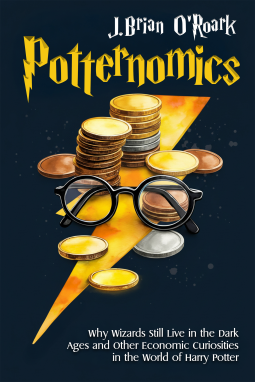
Potternomics
Why Wizards Still Live in the Dark Ages and Other Economic Curiosities in the World of Harry Potter
This title was previously available on NetGalley and is now archived.
Send NetGalley books directly to your Kindle or Kindle app
1
To read on a Kindle or Kindle app, please add kindle@netgalley.com as an approved email address to receive files in your Amazon account. Click here for step-by-step instructions.
2
Also find your Kindle email address within your Amazon account, and enter it here.
Pub Date Apr 21 2026 | Archive Date Mar 15 2026
Histria Books | Histria Perspectives
Talking about this book? Use #Potternomics #NetGalley. More hashtag tips!
Description
Discover the Shocking Economics of the Wizarding World!
The world of Harry Potter is filled with magic, mystery, and adventure, but beneath the surface lies an economy struggling in the dark ages. Potternomics: Why Wizards Still Live in the Dark Ages and Other Economic Curiosities in the World of Harry Potter reveals why the wizarding world, despite its magic, remains economically backward.
Explore fascinating questions through an economic lens:
- Why is there almost no economic growth in the magical world?
- How does the wizarding world grapple with the fundamental problem of scarcity?
- Why are goblins such ineffective bankers?
- From an economic standpoint, why should people be even more terrified of Dementors?
- Why do even the wealthiest wizards maintain a standard of living comparable to the 1700s?
- Could economics explain how Harry, a teenage wizard, defeated the most powerful dark lord?
Part textbook, part Freakonomics, Potternomics is an entirely fun exploration of the economic principles at play in your favorite magical universe. By applying economic concepts to this beloved setting, you'll gain a new appreciation for the story and see that the real magic lies in understanding the forces that shape the wizarding world. Uncover the economic curiosities that make the world of Harry Potter tick!
Advance Praise
This book is like a conversation with Dumbledore while knocking back a butterbeer in the Three Broomsticks. Everything you've ever wondered about the economics of the Wizarding World is illuminated by O'Roark's -- Dirk Mateer, author of Principles of Economics, University of Texas.
Harry Potter has magic―but does that mean the laws of economics don’t apply? Of course not! From Diagon Alley to concert tickets for the Weird Sisters, Brian O’Roark masterfully weaves economic
insights into the Wizarding World. This enchanting companion is perfect for anyone eager to explore economics through the adventures of The Boy Who Lived or for Potter fans who want to see their
favorite world in a whole new light.
-- Matthew Rousu, host of The Economics Happy Hour podcast, Susquehanna University
A masterful blend of economic theory and wizarding wonder! This engaging book highlights fundamental economic principles through the lens of Harry Potter's magical world. Both insightful and accessible, it's the perfect read for those seeking a deeper understanding of the economic forces at work behind the scenes at Hogwarts. This book is a must-read for economics students and Potter enthusiasts alike.
-- Abdullah Al Bahrani, author of Economics with Dr. A newsletter and host of Economics with Dr. A YouTube channel.
The greatest Muggle economist of our time, O’Roark proves that economics still rules in the wizarding world. This is the most magical book ever written about Harry Potter and economics―no spellwork required.
-- Jadrian Wooten, Virginia Tech University, co-host of the Economics Happy Hour Podcast and author of the Monday Morning Economist newsletter.
Available Editions
| EDITION | Paperback |
| ISBN | 9781592116874 |
| PRICE | $19.99 (USD) |
| PAGES | 200 |
Links
Available on NetGalley
Available to Buy
Buy on Amazon Buy on BN.com Buy on Bookshop.orgAverage rating from 15 members
Featured Reviews
 Deviant Quill R, Reviewer
Potternomics is exactly the kind of book that makes you grin while simultaneously groaning if you're an absolute Potterhead, but I'm not mad at it. The author takes the whimsical world of Harry Potter and puts it under an economist’s microscope, arguing that magic hasn’t magically fixed structural problems. Wizards are, according to him, trapped in an inefficient, stagnant economy, held back by isolationism, terrible banking, and a chronic resistance to innovation. Even in a society where you can conjure water or teleport across the country, money and capital still matter, and O’Roark treats that seriously, sometimes brutally.
The sections on Gringotts are genuinely satisfying. He breaks down why a bank that just hoards gold instead of lending it out kills any chance of growth, and why that explains the lack of wizarding startups or real innovation. The Statute of Secrecy is treated as a trade barrier that kept wizards economically flat while the Muggle world exploded with industrial growth. It’s a bleak but convincing picture, and he makes it feel like you’re seeing the Wizarding World through a slightly sad, painfully logical lens.
Where the book falters is in trying to fit human drama into economic models. Game theory applied to Harry and Voldemort’s duel is clever on paper, but it stretches credibility. Voldemort is not making rational decisions to maximize profit or utility; he’s a megalomaniac obsessed with immortality. When characters driven by love, loyalty, and trauma are reduced to economic actors, some of the story’s soul gets lost.
There’s also a strong Muggle bias running through the book. Wizards are repeatedly judged for not producing Muggle-style industrial growth, but the book underestimates what magic allows them to do. Do you really need a consumer electronics sector if you can teleport, heal broken bones, or multiply goods within the limits of Gamp’s Law? The insistence on scarcity sometimes feels like it’s forcing magic to fit into a framework that it doesn’t naturally belong in.
Still, it’s a fun, nerdy thought experiment. It’s a book that will make you think about the Weasleys’ finances in a way you never wanted, and appreciate how weirdly fragile the wizarding economy really is. More an Economics 101 course with Harry Potter sprinkled in than a definitive critique of Rowling’s world, but entertaining and clever in equal measure.
Clever, sharp, and the kind of nerdy fun that makes you rethink the economics of magic without ever feeling dry.
 Jasmine N, Reviewer
An entertaining look into the wizarding world from an economic perspective.
As a Potterhead, some aspects of the book just didn't land for me, particularly the mention of the duel between Harry & Voldemort and the author's take on this. There wasn't really any rationality on Voldemort's end there.
As a whole, it's a great book and a unique view into the economics of the wizarding world and certainly makes you think! It's not something I would normally pick up but I'm very glad that I did and would encourage all Potterheads to do the same.
Thanks to NetGalley & Histria Books for the ARC.
Hillary C, Reviewer
Thank you to NetGalley and Histria Books for the ARC!
I somehow avoided ever taking an economics class so I was a bit worried when I started the book that it would be dense and difficult to understand, however that was not the case! Framing economics in the context of something I was already familiar with, such as the Harry Potter universe, made it more palatable and easier to comprehend, even with intimidating topics such as game theory. Overall it was an approachable intro to economics and I enjoyed it being in the Harry Potter universe.
Readers who liked this book also liked:
Publishers Lunch
General Fiction (Adult), Nonfiction (Adult), Teens & YA




Céline Fitzmaurice
Biographies & Memoirs, Mystery & Thrillers, True Crime
Cheng'en Wu
Comics, Graphic Novels, Manga, Multicultural Interest, Teens & YA