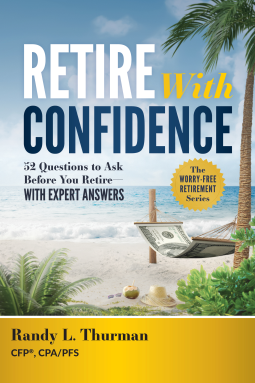
Retire With Confidence
52 Questions to Ask Before You Retire—With Expert Answers
This title was previously available on NetGalley and is now archived.
Send NetGalley books directly to your Kindle or Kindle app
1
To read on a Kindle or Kindle app, please add kindle@netgalley.com as an approved email address to receive files in your Amazon account. Click here for step-by-step instructions.
2
Also find your Kindle email address within your Amazon account, and enter it here.
Pub Date May 12 2026 | Archive Date May 12 2026
Talking about this book? Use #RetireWithConfidence #NetGalley. More hashtag tips!
Description
Most Americans spend more time planning a vacation than planning their retirement. If you’re among the millions approaching this life-changing transition, you can’t afford to wing it.
Retire With Confidence eliminates the guesswork with answers to 52 essential questions every pre-retiree should be asking. This comprehensive guide leads you through the critical decisions that will make or break your retirement—from Social Security and Medicare to investments and tax strategy.
Perfect for:
- Adults 50+ considering retirement
- Anyone within 10 years of leaving the workforce
- Financial advisors seeking client resources
- Adult children helping aging parents
Inside, you’ll discover how to:
- Calculate your true retirement needs
- Optimize Social Security and Medicare decisions
- Navigate complex
- tax implications
- Protect your legacy and loved ones
- Avoid the costliest retirement mistakes
Written by a nationally recognized retirement advisor with decades of experience, this isn’t another generic retirement book filled with one-size-fits-all advice. Each question is designed to address your unique situation and guide you toward personalized solutions. Don’t let uncertainty rob you of the retirement you’ve earned. Get the clarity and confidence you need to retire successfully.
Your future self will thank you.
Available Editions
| EDITION | Other Format |
| ISBN | 9798891883895 |
| PRICE | $19.99 (USD) |
| PAGES | 308 |
Available on NetGalley
Available to Buy
Buy on Amazon Buy on BN.com Buy on Bookshop.orgAverage rating from 8 members
Featured Reviews
 Eric G, Educator
As one whose retirement came all of a sudden, this book came at the right time as well. Informative. Great insights and ideas which I can’t wait and will use on my journey to this new stage in my life.
 Paula, E, Reviewer
Retire With Confidence: 52 Questions to Ask Before You Retire—With Expert Answers by Randy L. Thurman had a lot of good information and lots to consider before retirement. I am nearing retirement, and this is a good resource to have regarding all the tax issues, tax payments, longevity and planning, etc. It's a lot to consider!
This book is an invaluable resource for anyone approaching retirement. The book addresses a critical gap in financial planning where, as the author says, many people spend more time planning vacations than considering their financial futures. What I liked most about this guide is its structured approach. The 52 essential questions serve as a roadmap, guiding readers through the complexities of retirement planning. From understanding Social Security and Medicare to making informed investment choices, each topic is clearly explained, making it accessible for those, like me, who may not have a financial background. The author offers practical advice and expert insights that help demystify the often-overwhelming world of retirement planning.
I also found it refreshing that this book is tailored for a variety of readers—whether you’re an adult over 50, someone nearing retirement, or even a financial advisor looking for client resources, there's something here for everyone. Additionally, adult children looking to assist aging parents will find this guide highly beneficial. Overall, Retire With Confidence is a must-read for anyone serious about their retirement planning.
I would recommend having this book on your shelf as a valuable resource.
#RetireWithConfidence #NetGalley @AdvantageFamily
 Demetris P, Reviewer
Why “Enough Money” Is Not Enough
“Retire With Confidence” shows how taxes, healthcare, inflation, scams, survivor benefits, and one wrong checkbox can unsettle even a well-saved retirement
By Demetris Papadimitropoulos | April 27th, 2026
Retirement confidence, in Randy L. Thurman’s “Retire With Confidence,” is not a mood, a brochure-blue beach chair, or the self-satisfied glow of a spreadsheet that has finally agreed to behave, briefly. It is what remains after a reader has asked enough unglamorous questions: What if I live to 100? What if Medicare covers less than the mental brochure promised? What if my spouse dies first?
And then come the questions with teeth. What if I claim Social Security too early, choose the wrong pension payout, roll over the wrong account, miss a required distribution, trust the wrong advisor, or mistake the label “safe” for the thing itself? The title promises reassurance. The method is more bracing. Thurman builds confidence by making the reader suspicious of confidence that arrives before the footnotes.
This is useful because Thurman is not selling the linen version of retirement, where the future arrives early, boards first, and has no copay. “Retire With Confidence” is a hazard map for the competent saver still being chased by fine print. It moves through the terrain that appears when payroll stops doing the quiet administrative work of adulthood: benefits, tax withholding, retirement accounts, healthcare choices, cash flow, scams, and the foggy business of finding advice that is not merely sales in nicer shoes. The 52-question frame is not packaging; it is the book’s operating system. Retirement, Thurman suggests, becomes less frightening when the questions arrive before the calendar, the form, or the widowhood decides for you.
Dave, one of the book’s early cautionary figures, has enough money to retire and still lasts only six months before wanting to return to work. The house projects are done, the visits made, the vacation taken, and then comes the strangely brutal morning when no one is waiting for him to arrive. Financial readiness, the book insists, does not automatically provide identity, structure, social contact, or a reason to get dressed before lunch. This is one of Thurman’s saving instincts: he knows that planning is not only a defense against poverty, taxation, inflation, and paperwork with consequences. It is also a defense against that empty morning.
Once purpose is on the table, the guide turns to the cash-flow machinery: spending, income, withdrawal order, benefit timing, tax exposure. In the spending chapter, Thurman rejects the borrowed rule that retirees need 60 to 80 percent of pre-retirement income. Mike, an elderly doctor, believes he cannot live on less than $1 million a year. Wilma, a widowed homemaker, wonders whether she can afford a modest trip to a sewing-machine museum. Together, they do what a chart cannot. Need is not a percentage. It is a temperament wearing a budget. Thurman recommends both a basic spending plan and a dream spending plan, a distinction that captures one of the book’s wisest instincts: planning should keep you alive, yes, but it should also give you permission to spend a little of the life you preserved.
The guide proves its worth when it turns regulations into missing checks, tax bills, and widows’ math. Susan remarries at 59, happy and newly in love, only for Thurman’s “financial planner heart” to sink because waiting until 60 would have preserved eligibility for valuable surviving-spouse Social Security benefits. Donna expects both Social Security checks and her husband Derek’s pension income to continue after his death, then learns that the household benefit shrinks and the pension disappears because Derek chose a single-life option. An engineer checks the wrong box on a lump-sum pension distribution form and turns a form into an $80,000 withholding problem, fixable only because he acts quickly and has cash available.
Other examples widen the risk map from technical error to misplaced trust. Mark and Jim both need income before 59½, but one is suited to substantially equal IRA payments while the other is better served by leaving money in a 401(k) under the rule of 55. Ruth and Ruby, widowed retirees with almost identical assets, arrive at very different spendable income because one stages her withdrawals so the tax bill does not eat the month. Bill leaves Thurman for an advisor promising 20 percent returns with hardly any risk, partly because the man goes to his church, and loses his savings in a Ponzi scheme. These are not scenes in a literary sense. They are advisor-desk cautionary tales with paperwork attached. Their drama lies in disproportion: a month, a form, a box, a payout election, a claim date, a tax threshold, an account type, a trusted acquaintance, a word like “guaranteed.” Any one can become the hinge on which a retirement turns.
Thurman’s prose is useful without self-consciousness. He writes like someone who has explained the same rule across the same desk often enough to know the exact moment when anxiety turns into fog. The acronyms arrive – RMD, FRA, COLA, SoSEPP – but he usually translates them before they can put on lab coats and intimidate the room. The diction is kitchen-table finance with calculator ink on its sleeve: nest eggs, land mines, storms, magic money trees, Swiss Army knives, sneaky little buggers, Uncle Sam. Inflation becomes a goblin nibbling away at purchasing power. Illiquid investments are tools best left in the toolbox. Pension decisions are compared to tattoos, permanent enough to demand sobriety, though probably less fun to display at a cookout.
The style is not decoration; it keeps the anxious reader from bolting. Thurman’s little pressure valves make Social Security formulas, Medicare gaps, pension calculations, tax thresholds, and advisor compensation models feel survivable. A guide that frightens readers back into avoidance has failed before it begins. Still, the winks sometimes brush against pain. Widowhood, dementia care, scam callers asking for routing numbers, long-term care costs, and financial loss are freight the jokes cannot always lift. The tone is usually controlled, but there are moments when less brightness would give the wound more room.
The form is triage disguised as a table of contents. The 52-question design could have become a tidy gimmick; instead, it enacts the book’s philosophy. Ask before you act. Check before you sign. Know the rule before the deadline turns from abstract to expensive. The progression matters: emotional readiness, spending, income sources, Social Security, pensions, retirement accounts, alternate income, investments, taxes, hazards, and finally advisors. That order prevents the book from treating retirement as merely an investment puzzle. It is first a life puzzle, then a cash-flow puzzle, then a rules puzzle, then a protection puzzle. Only after the reader has seen the maze does Thurman turn fully to the question of whom to trust with the machinery.
The back matter makes this a book to keep near the retirement folder, not bury in the read-and-done pile. The resources point toward life expectancy calculators, Social Security tools, Medicare books, planning platforms, and behavioral finance titles. The glossary is long, plain, and genuinely useful. Even the acknowledgments have weight here, because Thurman notes review by several credentialed professionals, including a specialist who read the Social Security chapter. In a retirement guide, technical review is one of the load-bearing beams.
Placed beside “How to Make Your Money Last” by Jane Bryant Quinn and “Retirement Planning Guidebook” by Wade D. Pfau, Thurman’s book is warmer and more anecdotal, less dense in the actuarial weeds than the latter and less journalistically polished than the former. It also touches, more briefly, the terrain of “The Retirement Maze” by Rob Pascale, Louis H. Primavera, and Rip Roach when it admits that retirement can disturb identity, marriage, routine, and purpose. But Thurman’s sharpest talent is staging the danger before it becomes a bill. He gathers subjects many readers know only as loose parts – benefits, pensions, taxes, accounts, healthcare, scams, advisors – and shows how each can alter the others.
What he does best is not invent advice, but plant the warning sign before the reader reaches the wire. The anxious saver, in these pages, is not treated as foolish. Anxiety is treated as evidence that the reader senses something true: the years after payroll stops making decisions for you are full of thresholds, exceptions, dates, penalties, and irreversible elections. A person may save diligently for 30 years and still not know which account to draw from first. A person may have a pension and still leave a spouse exposed. A person may own a home and still misunderstand the cost of borrowing against it. A person may have a portfolio and still confuse volatility with danger, guarantees with safety, or trust with verification.
Here is the book’s most persuasive insight: confidence is not certainty. It is preparedness with a pencil behind its ear. It is the habit of asking where the hidden consequence might be: the date inside the benefit, the tax bracket inside the withdrawal, the spouse inside the pension choice, the scam inside the good news. Claiming Social Security affects taxes and survivor income. Pension elections affect spouses. RMDs affect tax brackets. Roth conversions affect future flexibility. Medicare choices affect doctors and costs. Cash reserves affect whether an emergency forces a bad sale. Advisor choice affects nearly everything. Thurman’s repeated answer, unsurprisingly, is “it depends.” This is honest. It is also, by the fifth or sixth appearance, a verbal ottoman one keeps tripping over in the hallway. Yet the repetition has a purpose. The book is trying to save readers from advice that becomes dangerous precisely because it is too clean to be safe.
The price is that nearly every channel eventually points toward the same harbor: professional help. “Retire With Confidence” is written from inside an advisor’s worldview. Thurman is candid about his bias, and his chapter on choosing an advisor is one of the book’s most valuable sections. Ask whether the advisor is a fiduciary all the time. Understand fee-only versus fee-based versus commission-based compensation. Ask about exit costs, rebalancing, tax reporting, liquidity, and independent custodians. This is armor made of unglamorous questions, not mere self-advertisement. Still, the harbor is clear. For many readers, that may be excellent advice. For others, especially those with less room for error, heavy debt, renting status, precarious healthcare, or little access to high-quality fee-only guidance, the implied reader may live closer to the asset-owning middle than to the edge.
There is also the calendar rot that comes for every tax table. Social Security limits, RMD ages, Medicare premiums, QCD caps, healthcare costs, and legislative provisions age on contact. Thurman knows this and repeatedly tells readers to verify numbers that still belong to the current tax year. That caution helps. It also clarifies where the book’s durable value really lies. Not in any single figure, but in the habit it cultivates: check the rule, ask the next question, look at what comes before what, distrust the too-smooth promise.
Every so often, the gears clack. Inflation is the monster under several beds. Professional guidance returns with the persistence of a well-dressed homing pigeon. Chapter recaps sometimes explain what has already been explained, then escort the reader to the next section with a hand on the elbow. This is not ruinous. In a practical rulebook, repetition can be mercy. But as a reading experience, the pattern becomes visible: anecdote, question, answer, caveat, list, advisor nudge, summary, transition. The engine works. One can still hear it.
The book does not have to shout its relevance; inflation, healthcare costs, fraud, and benefit uncertainty are already doing the shouting. These pressures are not pasted onto the argument from the outside. The chapters keep finding them at the advisor’s desk, on the phone, in the hospital bill, in the widow’s missing income, in the scam caller’s script, in the retiree who has enough money but no reason to get up. Thurman is not writing a grand theory of American retirement, and the book is better for not pretending otherwise. Its discipline is staying close to the form, the account, the spouse, the monthly cash flow, the rule that sounds small until it costs thousands.
That closeness gives the book more human weather than its category promises. Beneath the account rules and tax strategies is a question no calculator can quite answer: what does confidence mean when certainty is unavailable? Thurman’s answer is pragmatic, almost stubbornly so. Confidence is a spending plan, a cash reserve, a survivor option, a delayed claim when appropriate, a tax-aware withdrawal order, a diversified portfolio, a trusted contact form, a purpose beyond work, and the humility to know when the form in front of you is not harmless paperwork.
My final rating is 82/100, or 4/5 stars. The number suits a book that is strong in structure, humane in impulse, and valuable at the moment before the wrong deadline, signature, payout choice, withdrawal, advisor, or assumption becomes expensive. It is not a book to quote for verbal fireworks, but it is one many readers may reopen before a consequential meeting, which is its own kind of praise.
“Retire With Confidence” will not make retirement glamorous, and it is not interested in pretending otherwise. Its wisdom is plain, protective, and deliberately unglamorous. The future does not become safer because a single large number smiles back from a spreadsheet. It becomes safer when someone walks the route slowly, checks the weather, asks who is driving, and notices the cliff before the shortcut starts wearing the mask of wisdom.
 Ann M, Reviewer
I have read a lot of books on preparing for retirement (I am a planner!0. What sets this book apart is it is framed around the 52 questions to ask before you retire. From am I ready - emotionally and financially to how much will I need (sorted into different revenue and expense streams). There is also a section on threats and hazards to take into account when planning and a great section on deciding whether you will need a financial advisor to help guide you. At the back o the book are resources for more information.
Thank you to Netgalley and Advantage Books for an ARC and I voluntarily left this review.
 Susan H, Reviewer
The author has 40 years of experience guiding people into retirement. He realized that in the seminars he taught, most people asked the same questions, so he decided to write a book to answer the most important and common questions.
The first chapter covers 2 questions. The first may seem easy to answer until you become retired and wonder how to fill your time. “Am I ready to Retire?” He explains emotional readiness and financial readiness.
The next chapter is the chapter that everyone has – “How Much Money Do I Need? He spells out that things that you’ll need money for. He provides several different categories to consider when you put together your spending plan. Worksheets are provided to help you identify where your money will be coming from and what you’re likely to spend it on. What is your life expectancy and how to plan for inflation.
Chapter 3 is “Social Security Income.” I personally thought I had a good idea of what Social Security was all about, but when I retired, I realized how little I knew. This chapter not only explains a lot, it provides some good strategies.
Chapter 4 explains “Pension Plans.” If you’re lucky enough to be covered by one, there are potentially more options for how you’d like it distributed than you may have thought.
Chapter 5 covers “Retirement Accounts.” You know, the places where you have stashed money for retirement? You might want a plan on how to withdraw your savings to optimize what you’ve saved.
Chapter 6, “Other Sources of Income” explores exactly that.
Chater 7 discusses “Investment Strategies.” After you’re retired, your investment goals and strategies will probably need to be adjusted because your needs and income will change. The author explains a number of options and strategies with excellent explanations.
Chapter 8 is all about “Tax Strategies.” This is an area that many of us forget about. Do you know when you are required to withdraw from your tax-sheltered retirement accounts? How will that affect your taxes? I found his advice to be very useful.
Chapter 9 covers “Threats and Hazards.” This is a great chapter to read to uncover some threats to your security as you age, and how you spend your money. You may not even be considering it yet, but elder fraud is real and more common that you might think. We think we’re sophisticated enough to avoid these scams, but the fraudsters are very sophisticated.
Chapter 10, “Do I Need a Financial Advisor?” I found lots of good advice in this chapter and although I’m not an advisor, I think that I’m quite well informed. The author asks, “How can I find a trustworthy retirement advisor.” He guides you with 6 additional questions with detailed comments that are excellent. This may be the most important chapter in the book, in my own opinion.
The last section of the book provides resources, both books, and websites.
This book is an outstanding starting point. And by that, I mean that he provides the questions and discusses some of the options that you should be thinking about. The author guides you to consider your own situation. And provides a pathway for you to chart out your plan. If you would like to get more in-depth information, his references should be of great value to you.
I received an early version of this e-book. Thank you to NetGalley and the publisher.
Rebecca F, Reviewer
This is a terrific high level view of things to consider as you approach retirement, regardless of what age. Even difficult topics such as tax considerations and various payout options for investment and retirement accounts are explained in easy to understand language. The author is a certified financial planner who (rightly) suggests people need someone like him to navigate retirement due to the complexity of tax laws and the uncertainties of health and life span.
Don’t miss the included glossary of terms and a fantastic list of resources for more information.
I highly recommend this book for those nearing retirement or who have loved ones considering it.
Family friendly.
Thanks to NetGalley and Advantage Books. I received a complimentary copy of this book. Opinions expressed in this review are completely my own.
Readers who liked this book also liked:









Marie Bostwick
Historical Fiction, Literary Fiction, Women's Fiction

Marie Bostwick
Historical Fiction, Literary Fiction, Women's Fiction