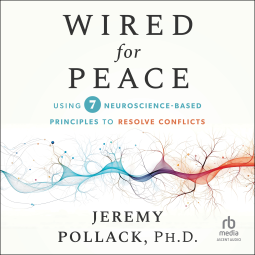
Wired for Peace
Using 7 Neuroscience-Based Principles to Resolve Conflicts
with Paul Boehmer (Narrator)
This title was previously available on NetGalley and is now archived.
Send NetGalley books directly to your Kindle or Kindle app
1
To read on a Kindle or Kindle app, please add kindle@netgalley.com as an approved email address to receive files in your Amazon account. Click here for step-by-step instructions.
2
Also find your Kindle email address within your Amazon account, and enter it here.
Pub Date Jun 3 2026 | Archive Date Jun 9 2026
RBmedia | Ascent Audio

Talking about this book? Use #WiredforPeace #NetGalley. More hashtag tips!
Description
Drawing from neuroscience, social neuropsychology, predictive-processing theory, and decades of applied conflict resolution practice, Wired for Peace presents a transformational model for understanding why conflict escalates and how sustainable peace is created. Moving beyond traditional communication-skills or mediation-only approaches, this book shows that lasting conflict resolution begins with the autonomic nervous system and the brain's threat-prediction mechanisms. The book illuminates the internal neural architecture that determines how individuals perceive danger, construct narratives, react to stress, and attempt either protection or connection. Authored by Dr. Jeremy Pollack, an organizational psychologist, conflict resolution expert, and founder of Pollack Peacebuilding Systems, the work examines:
- How the autonomic nervous system, predictive processing, and neuroplasticity shape threat perception, emotional reactivity, and conflict escalation.
- Why conventional modalities such as facilitated dialogue, communication training, leadership coaching, or mediation often fail unless underlying neural dysregulation is addressed.
- How internal conflict, interpersonal conflict, group conflict, and organizational conflict share the same evolutionary and neurobiological foundations.
- The real organizational costs of dysregulated systems, including culture erosion, burnout, turnover, chronic mistrust, and impaired decision-making.
- And more
Available Editions
| EDITION | Other Format, Unabridged |
| ISBN | 9781663760081 |
| PRICE | $24.99 (USD) |
| DURATION | 8 Hours |
Available on NetGalley
Available to Buy
Buy on Audible Buy on Kobo Buy on Libro.fmAverage rating from 4 members
Readers who liked this book also liked: