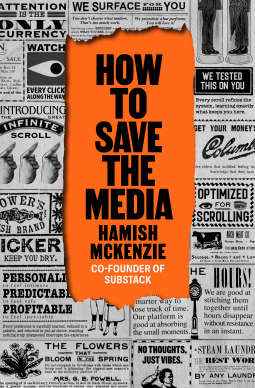
How to Save the Media
Sign In or Register Now to see if this title is available for request.
Buy on BN.com Buy on Bookshop.orgSend NetGalley books directly to your Kindle or Kindle app
1
To read on a Kindle or Kindle app, please add kindle@netgalley.com as an approved email address to receive files in your Amazon account. Click here for step-by-step instructions.
2
Also find your Kindle email address within your Amazon account, and enter it here.
Pub Date Nov 17 2026 | Archive Date Not set

Talking about this book? Use #HowtoSavetheMedia #NetGalley. More hashtag tips!
Description
Social networks tore apart a media industry that had taken two hundred years to build, swapping broadsheets and broadcasts for algorithms and addiction feeds. Now what?
The media is in chaos even though its fundamental job hasn’t changed. The demand is still there: people still crave great stories and robust reporting. And there’s no shortage of supply: there are more creators than ever. But the old models built to connect the supply and demand no longer work.
As a young journalist, Hamish McKenzie knew the ground he was stepping onto was already shaky, and that was even before he worked for and then tangled with Elon Musk. When he teamed up with Chris Best and Jairaj Sethi to found Substack, he believed that new infrastructure and new business models could usher in an era where independent voices have power and audiences have a say.
In How to Save the Media, we get to ride along, witness to an industry in metamorphosis. We’re there at the Hotel Chelsea, barside with whiskey-drinking legends of newsrooms past. We’re there at Cannes Lions, where sweating ad executives on luxury yachts are busy divvying up the very revenue that once kept newsrooms alive.
And we’re there as pioneers of the new creator economy wrestle with the promises and pitfalls of what they’ve built.
Available Editions
| EDITION | Other Format |
| ISBN | 9798893312034 |
| PRICE | $26.00 (USD) |
| PAGES | 192 |
Available on NetGalley
Available to Buy
Buy on BN.com Buy on Bookshop.orgAverage rating from 5 members
Featured Reviews
 Ann D, Reviewer
Fantastic book. It was hard to put down. I was expecting a dry marketing book but got a rich. visual, wonderfully written story and framework from someone who's in the thick of it and has a lot to say. Surprising, fascinating, and fun to read.
 tej d, Reviewer
This book was of particular interest to me because I publish on the Substack platform and am fascinated by the community, its culture, vibes, and audience tools. Thank you, Netgalley, for sharing the ARC.
The book is a welcome first-person account from the author with a near-perfect vantage point of telling the antecedents, the origin story, the process of building, critical decision points, and ultimately the story of writers who complemented the founders' vision for this new media and platform. Though others had tried (Medium) and competitors exist (Patreon), Substack has a feel and community that's uniquely its own.
I don't believe the book is true to its title as it does not provide a blueprint to "Save the Media". However, the history of how and why the platform was built, the ethos of writer-owned publications, subscription drivers, freedom of speech, content moderation etc. are all individual decisions that collectively made Substack. I think the book could almost be called a version of "the butterfly effect" of a new medium.
The book does a great job of presenting history, politics, subject, and philosophy in bite-sized chapters. Though storytelling enters 'dad mode' occasionally, moving from journalism of telling the 'what happened' to opinion telling us 'why it happened', it stops short of advice and never really tells 'what to do' to actually earn the book's title 'how to save...".
It is a must-read for any Substack author to better understand the platform that provides their publications a home. It is also instructive in telling the story of how it has shaped positive discourse in a sea of negative and doomscrolling social media.
 Reviewer 240007
AS someone who has been in the media my whole career, there are a lot of truths and realities here. Bottom line is that the media is important and the first amendment needs to be protected. Every little bit helps. Thanks for the early read
 Jim R, Reviewer
I use Substack. Not well, as I have yet to be able to focus on my own writing ideas, so for now I am mostly a curated feed consumer. And yes, this is a story of Substack. And some of Mr. McKensie’s stories. He makes the assertion that people paying for the content they want is better than the majority of platforms feeding them what the platforms’ algorithms want. And that will save [the] media.
I accept the assertion, with a caveat: those other platforms aren’t going away. In a short-attention-span click-bait-consumers doom-scrolling-bubble and so tragically sad near complete absence of critical thinking “social” media users’ world… yeah, the bad stuff grossly outweighs the good intentions. And again, it’s not going away.
A more accurate title might be How to Save *Some* Media. Clearly the journalists bolting from (or being chased off of) MSM who have found a home on Substack. And despite millions of paying subscribers, there are tens of millions, if not hundreds, content to consume, believe, and spread whatever fits their confirmation biases. Still, millions isn’t small and we hopefully cultivate incremental gains. You’ll get the hopeful theme throughout.
“When we talk about saving the media, we're actually talking about strengthening the way we build trust and understanding with each other.
We've gone through a destabilizing couple of decades. The years ahead can be better. As technologies become more powerful, and machines do more of the work of production, everything we build should act in service of our social bonds. We can use technology to strengthen rather than erode our relationships.”
I appreciate the publisher making this available through NetGalley.
Some of my thoughts on some of Mr. McKensie’s thoughts:
[Ah, the Twit]
“Twitter represented everything we wanted to move away from. It was a system that had mastered the art of information addiction but mostly served up pique and agitation.”
{Definitely agitation. Any value it had as a quality information source/resource (20 years ago) was long gone before their acquisition.}
[Re: Bezos directing radical editorial shifts of WaPo, and the fallout]
“Bezos was a convenient target, but the Post's problems were the same as those that had challenged most newspapers since the advent of the advertising apocalypse, set in motion by the arrival of Google and Facebook in the 2000s.
[…]
The truth was that the newspaper's glory days were over. Not just the Post - all newspapers.”
“When was the last time you read a printed paper? Yes, online is the model now, but even then, I only look at the free articles and usually only to see what is written before I go off to look for as-primary-as-I-can-get sources.}
[Responding to backlash on some rather vile publishers on Substack]
"A lot of people suppose that we started Substack to be the next big thing in journalism. But what we're actually trying to do is subvert the power of the attention economy," we wrote. "We want people, not engagement-motivated platforms, to ultimately be in control."
[Liable for content, or not?]
“Centralized platforms that mediate the relationship between their users— deciding what gets distributed, recommended, rewarded, and removed-are more responsible, legally and practically, for what flows through their systems. Substack works differently. Publishers own their content and their mailing lists, and their audiences subscribe to them directly. The primary source of connection is their inbox, which subscribers explicitly invite publishers into and can kick them out of any time.l
{I am in the FB, Twit, Google, YouTube, you name it are liable if their algorithms push content (for engagement).}
[How to keep your users]
“Social media platforms are the major gatekeepers of today's information system. While many of them aspire to ideological neutrality, their biases are expressed in their business models. The content they prioritize is actively selected by an algorithm optimized for a particular goal. In Facebook's case, it might be time spent in the app. In Substack's case, it's the number of subscriptions created.”
{He’s carefully kind to FB specifically here. The analyses and leaked internal communications have shown the goal is to keep people scrolling no matter the social cost. And “ideological neutrality”? They give lip service on the face, but they certainly don’t aspire to it.}
[Oh, but you used to be someone I liked before you said something bad about someone I liked]
“It's reasonable to worry that the direct-relationships model rewards those who simply tell their audiences what they want to hear, reinforcing preexisting biases rather than challenging them. There are writers on Substack who succeed by staying safely within party lines, as well as hucksters who exploit tribalistic impulses for personal gain. I know of writers whose subscription revenues have slumped when they've spoken out against political leaders their readers had assumed they supported.”
{Even enlightened consumers fall prey to a binary paradigm. Either/or is intellectual dishonesty. Questioning someone you support shouldn't be an anathema; it should be the default. Do I think President Obama was an excellent president? Yes. Did I like/agree with every thing he did? Not only no, but... And when you find good news after the questions, all the better. Keep digging.}
[This was an welcome eye-opener]
“However, I am proud of how Substack has led the way with legal support for creators. In 2020, Chris came up with the idea of launching a program to connect independent creators with lawyers to face down intimidation from the subjects of their reporting. Substack pays the bills. We've now expanded that program, Substack Defender, to cover multiple countries, including the U.K., France, Canada, and Australia. I hope other platforms follow suit.”
{Wow}
Reviewer 1870399
Thank you, Authors Equity, for providing this book for a voluntary review via NetGalley. All opinions are my own.
In How to Save the Media Hamish McKenzie, co-founder of the online media platform Substack, discusses how trust in journalism has eroded and how this erosion is both a cause and effect of polarization. McKenzie traces the history of journalism from the use of pamphlets (e.g., Thomas Paine’s Common Sense) to the development of the printing press to the birth of the internet to the emergence of social media companies, such as Meta and Twitter. He ties the erosion of trust to business models that prioritize engagement at all costs and at the expense of objectivity and trust. Social media companies seek to maximize the attention you pay to their content since this enables them to sell your attention to their customer, the advertiser. The result is sensationalistic, addictive, and hyperbolic news coverage rather than meaningful and objective news coverage.
McKenzie’s and his Substack co-founders’ insight was to steer away from an advertising-based business model towards a direct payment model where publishers have a direct relationship with their audience, who pay a subscription fee for access to the publisher’s content. McKenzie states, “Publishers build trust with their audiences over time, by what they publish and what they get right and wrong; audiences extend or withdraw that trust by subscribing and unsubscribing. These distinctions don’t completely solve the problem of regulating speech online, but together they offer a stronger foundation to work from.”
Regarding the regulation of speech, McKenzie discusses Substack’s philosophy on censorship. If both publishers and audiences know the platform defends free speech, they can be confident that the information sources are not being manipulated and can be trusted. This trust in turn strengthens relationships. In short, “censorship of bad ideas makes people less likely, not more likely, to trust good ideas.”
McKenzie describes his career path and what led him to found Substack. He describes the challenges he faced, the importance of journalism to democracy and trusting relationships in society, and his passion for Substack’s mission, which is helping “people communicate and understand each other, so we can see problems clearly and figure out how to solve them together. It is the ultimate community service work, spreading information and sharing stories . . . everything we build should act in service of our social bonds. We can use technology to strengthen rather than erode our relationships.”
I highly recommend How to Save the Media to anyone concerned about the integrity of journalism and how we access and consume news. In today’s increasingly polarized world, restoring relationships based on understanding and trust is something to strive for. Thank you, Hamish McKenzie, for this educational read and everything you’ve done at Substack.
Readers who liked this book also liked:

Paul S. Rothenberg
Biographies & Memoirs, Entertainment & Pop Culture









Paris Marx
Business, Leadership, Finance, Politics & Current Affairs, Professional & Technical