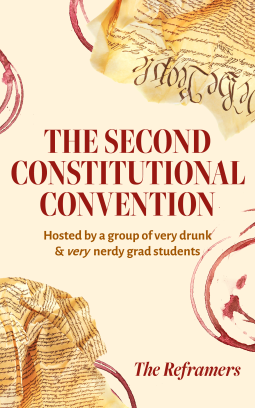
The Second Constitutional Convention
Hosted by a group of very drunk & very nerdy grad students
Sign In or Register Now to see if this title is available for request.
Buy on Amazon Buy on BN.com Buy on Bookshop.orgSend NetGalley books directly to your Kindle or Kindle app
1
To read on a Kindle or Kindle app, please add kindle@netgalley.com as an approved email address to receive files in your Amazon account. Click here for step-by-step instructions.
2
Also find your Kindle email address within your Amazon account, and enter it here.
Pub Date Nov 6 2026 | Archive Date Jan 31 2027
Whitehorn Media Group, LLC | Long Story Short Press
Talking about this book? Use #SecondConCon #NetGalley. More hashtag tips!
Description
Sarah Vowell with a policy agenda. How Democracies Die, if it were funny.
Rome did it. Britain did it. America has done it once already and (check the news) is cheerfully lining up for a second attempt. History's experiments in self-government keep tearing themselves apart through the same grim sequence, executed at every step by the same people making the same moves that supposedly made complete sense at the time. This book walks you through the violent collapse of all three. Then it refuses to let you conclude it has to keep happening.
We started with one question: why does this keep happening? A decade and one very long hangover later, we have returned with an answer, a blueprint, and a permanent grudge against the prisoner's dilemma.
You'll meet the Roman senators who killed the Republic trying to save it. The king who had a rather terminal disagreement with his parliament. Thirteen colonies that agreed on absolutely nothing except who they were against — which, it turns out, is not a governing philosophy. You'll watch the same machine grind through three thousand years and three continents with the mechanical predictability of a toddler approaching a wall socket.
By the halfway point, you may be convinced it's hopeless. Keep reading anyway. Because we can stop history from repeating itself, but only if we accept why it always does. The back half takes at least that part seriously: it quits diagnosing and starts building. Ranked-choice voting. Multi-member districts. An end to the imperial presidency. A constitutional system engineered to keep working when operated by the absolute worst people you can imagine. Which is convenient, because those are almost certainly the people who'll be operating it.
Every claim is built to be checked.
Part stand-up comedy set, part repair manual for an aging republic, part group therapy for anyone who has ever watched a government shutdown and thought: surely this is not the best we can do.
It isn't. So pour yourself a drink. The convention is now in session.
A Note From the Publisher
Advance Praise
"One of the best books I've read this year… The history side is fantastic, the policy recommendation half is fantastic. Highly recommend for literally everyone that can vote." — NetGalley reviewer
"Genuinely funny and accessible… You don't need a law degree to get the jokes or follow the logic." — NetGalley reviewer
"This masterpiece offers a digestible, tangible blueprint that merits consideration… worth the read for anyone interested in preserving democracy." — NetGalley reviewer
Marketing Plan
Print editions (hardcover and paperback) publish in November 2026 — peak of the midterm elections, timed to election coverage of democratic reform. Ebook available now. Campaign highlights:
• Review and interview outreach to politics, history, and legal-affairs podcasts, Substacks, and independent media, September through December
• Pitch angles tied to the fall news cycle: the midterm aftermath, the new Supreme Court term, and the semiquincentennial
• Free excerpt (the introduction) available on the NetGalley listing • Print launch positioned for the holiday gift season
• Digital review copies available to media, librarians, booksellers, and educators through January 16, 2027
Available Editions
| EDITION | Paperback |
| ISBN | 9798951725004 |
| PRICE | $19.99 (USD) |
| PAGES | 423 |
Available on NetGalley
Available to Buy
Buy on Amazon Buy on BN.com Buy on Bookshop.orgAverage rating from 4 members
Featured Reviews
 Reviewer 1870399
Thank you, Whitehorn Media Group, LLC, for providing this book for a voluntary review via NetGalley. All opinions are my own.
I’ll start (and end) this review recommending The Second Constitutional Convention to anyone interested in constitutional history and democratic institutions. The first part of the book reviews the democratic governments of the Roman Republic and Roman Empire, the British Empire, and the United States. In each case, The Reframers discuss how the rules of society were developed and evolved, and how power-hungry actors manipulated the rules to gain power to the detriment of democratic principles and broader society. The question addressed is “what happens when following the rules becomes a disadvantage in the competition for power?” The second part of the book presents insightful proposals to close the loopholes in constitutional structure in order to restore and preserve democratic institutions. The question addressed is “how do you create political systems that consistently channel human competitiveness toward building things up rather than tearing them down?” Each of the proposals are sensible and worth serious consideration. The Reframers address most if not all of the potential challenges to their proposals with clearly explained rebuttals. The tongue in cheek humor of The Reframers made the reading experience quite enjoyable and brought a smile to my face on almost every page.
The Second Constitutional Convention contends that each generation of citizens must be committed to democratic institutions. They must review and preserve enforcement mechanisms, and be ready to defend inevitable attempts to subvert laws for short-term personal gain. When constitutional structure depends on humans voluntarily resisting temptations to gain power, the structure will not stand and will eventually fail.
The Reframers state three laws of politics:
• First Law – political polarization is inevitable; that is, people organize into groups and develop fierce and blinding loyalty to their group.
• Second Law – short-term thinking wins elections; that is, politicians will sacrifice long-term stability for short-term personal gain.
• Third Law – losers flip the board; that is, when politicians lose democratic elections legitimately, they will choose to dismantle the democratic institutions rather than accept defeat.
If polarization is inevitable, it is essential to avoid constitutional systems that map onto binary choices, thereby making every election existential. Once the two-party stranglehold is broken, polarization loses its ability to trigger the Second Law. If short-term thinking dominates political calculations, replace human discretion with mathematical formulas wherever manipulation is possible. Politicians can’t game the census if the methodology is locked behind a supermajority or gerrymander if the district math makes gerrymandering geometrically impossible. Align short-term incentives with long-term institutional health, so selfishness produces good outcomes instead of catastrophic ones, no matter what any politician tries to do. If losers flip the board when defeat feels existential, you have to design systems where losing doesn’t mean permanent exclusion.
The Reframers introduce sensible proposals to safeguard the US Constitution against the three laws of politics. The root cause of polarization is the two-party system, so The Reframers’ proposals enable at least three viable parties. If the political math is such that short-term decisions don’t increase or even decrease power, the decisions that are made are conducive of long-term stability. To address board flipping, make the consequences of doing so career-ending.
Here are brief descriptions of the key proposals:
• Change the electoral architecture to enable more than two viable parties by implementing ranked choice voting, multi-member districts, and a presidency that requires coalition building across party lines.
• Increase the number of representatives, based on a cube root calculation, from the current 435 to 690.
• Increase the number of senators to three per state (for 150 total) with one senator from each state up for reelection every two years.
• Instead of single-member districts, combine multiple districts that each elect 3 to 10 representatives based on proportional allocation of votes.
• Two-thirds of both chambers of Congress must approve census methodology and results before they can be used for apportionment or federal funding distribution.
• Compulsory voting, which negates every manipulation strategy for voter suppression. You can’t suppress voters who are required to vote. You can’t game the electoral college based on turnout when turnout is universal. Such a structure drives the need to win over voters and discourages negative campaigning.
• Establishing the role of the American Prime Minister to replace the current role of the Vice President as the President of the Senate. The American PM belongs to the legislative branch and speaks for Congress.
• Supreme Court decisions involving constitutional interpretation requires agreement from at least two-thirds of justices.
• Supreme Court vacancies must be filled within 3 months. Appellate courts within 6 months and district courts within 9 months.
The Reframers don’t claim their constitutional system is fail-proof. They do, however, claim that it can withstand the manipulation strategies that brought down the constitutional systems of Rome, Britain, and America discussed in the first part of the book. The Second Constitutional Convention gave me an appreciation of the fragility of our Constitution. I’ve read extensively about our Founders and the making of the US Constitution, and I found The Second Constitutional Convention truly engaging and educational, particularly the proposals to strengthen the safeguards of the Constitution, which I haven’t read about elsewhere. I highly recommend The Second Constitutional Convention as an essential read to ensure our democracy works for all citizens and endures for the foreseeable future.
 Pauline S, Reviewer
I saw this book on Netgalley and I was so curious about it I had to request a copy. I’m super happy I did because this might be one of the best books I’ve read this year.
This book is all about the democratic process. It spends the first half looking at the politics of Rome, the political history of Britain and most of the history of the US, and why it all failed. The second half is all about proposed changes to the system of the US that could help the system not eat itself.
The first half of the book was very interesting to read: I’ve been getting more into politics and history in general and I liked how this was written. It relates everything in a super easy to understand way and throws humor in the mix in a way that does a good job of mildly distracting you from how terrible it all is.
The second half of the book is where it really kicks off though. A system of reforms is proposed that would make politics in the US actually work. The things make sense. It all makes sense. Do I think modern politicians will like any of it and want to pass anything in here? Probably not. But the things in here would work.
Overall I had a really good time reading this. The history side is fantastic, the policy recommendation half is fantastic, overall everything is just, well, fantastic. Highly recommend this read for literally everyone that can vote in any way shape or form in the US (for everyone else too honestly this is just a good read overall.)
Reviewer 315097
Thank you to both #NetGalley and Whitehorn Media Group, LLC | Long Story Short Press for providing me an advance copy of The Reframers' #political #nonfiction work, The Second Constitutional Convention, in exchange for an honest review.
I was understandably skeptical about a novel that touts itself as part constitutional reform manual and part stand-up comedy, whose subtitle is quite literally, Hosted by a group of very drunk & very nerdy grad students. Those suspicions only deepened upon cracking open the #SecondConCon and discovering the text is formatted as well as initially reads like a series of blog posts written by AI, which is incidentally, the first subject mentioned in the introduction. My expectations naturally plummeted to the bowels of Hades, fearing the absolute worst: the work would neither be humorous nor instructive. Yet, this was for a review. Thus, I had no choice, but to sigh dramatically and turn the page.
That being said, by the conclusion, I was pleasantly surprised the book accomplished its main objective. I have suffered through one too many works and journal articles purporting to resolve the impending constitutional crisis, only to finish with crushing disappointment when the bulk of the content is a history lesson and the resolution a mere ten pages. No one is more ecstatic than I to report that this masterpiece offers a digestible, tangible blueprint that merits consideration. In a perfect world, a similar proposal would have been adopted centuries ago, but alas...
According to its anonymous authors, The Reframers, the work took ten years to write and is supported by numerous references whose included citations span roughly twenty pages. Despite the dense material, the content is accessible and entertaining. From quips to factual tidbits, such as the true account behind the lost colony of Roanoke, the reading never feels like a chore. If nothing else, this could easily serve as a supplemental textbook for AP government classes. Seriously. The nation would be better off if we educated our youth about the actual atrocities that founded and still persist in our ongoing political history.
The sole critique I have is that the book bills itself as comedy, potentially, attempting to grab buyers by saying its written by drunk grad students. While I was admittedly also intrigued for this reason, the moments of levity are so few and brief, I believe the subtitle is a disservice to the earnest research, contemplation, and design behind such a carefully-curated proposal. Overall, worth the read for anyone interested in preserving democracy.
 Tyler H, Reviewer
I wasn't sure what to expect going into The Second Constitutional Convention, mostly because reading about constitutional law usually feels like a fast track to falling asleep. But the Reframers actually pulled off something pretty impressive here: they made a deep dive into government structure genuinely funny and accessible.
Instead of getting bogged down in dense political jargon, the authors break down complex ideas with a sharp, witty tone that keeps the pages moving. The concepts are super easy to follow, and the whole premise—looking at what a modern reset of our core rules might actually look like—is presented in a way that feels surprisingly grounded and down-to-earth. You don't need a law degree to get the jokes or follow the logic.
My only real gripe is that a few sections tread a little light on the gritty practical details in favor of keeping the humor going, but honestly, that tradeoff is probably why the book stays so readable. It’s an engaging, entertaining read that will actually make you think without giving you a headache.
Thank you to the publisher and NetGalley for providing an advance reader copy in exchange for an honest review.
Readers who liked this book also liked:


Paul S. Rothenberg
Biographies & Memoirs, Entertainment & Pop Culture








Hamish McKenzie
Business, Leadership, Finance, Nonfiction (Adult), Professional & Technical

Paris Marx
Business, Leadership, Finance, Politics & Current Affairs, Professional & Technical

Judi Dench; Brendan O'Hea
Biographies & Memoirs, Nonfiction (Adult)