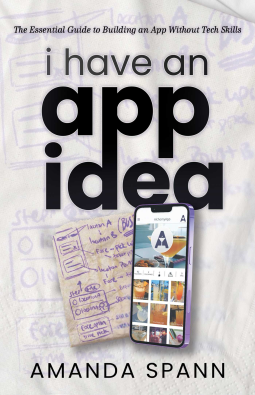
I Have an App Idea
The Essential Guide to Building An App Without Tech Skills
This title was previously available on NetGalley and is now archived.
Send NetGalley books directly to your Kindle or Kindle app
1
To read on a Kindle or Kindle app, please add kindle@netgalley.com as an approved email address to receive files in your Amazon account. Click here for step-by-step instructions.
2
Also find your Kindle email address within your Amazon account, and enter it here.
Pub Date Mar 10 2026 | Archive Date Mar 4 2026
Talking about this book? Use #IHaveanAppIdea #NetGalley. More hashtag tips!
Description
This workbook offers a step-by-step road map to guide nontechnical founders from concept to launch with confidence. Designed to break down the complexities of app development, it combines Amanda Spann’s personal experiences and proven strategies with interactive activities and worksheets that provide hands-on support every step of the way.
Through relatable stories, real-life examples, and practical tools, Amanda helps founders avoid costly mistakes and build products primed for success. With each chapter, readers will uncover strategies to validate their ideas, build sustainable businesses, communicate effectively with developers, and manage the development process—ensuring founders remain empowered and in control. This book demystifies app entrepreneurship, clarifies the essentials, and offers a solid foundation for creating scalable products—without the overwhelm.
This book demystifies app entrepreneurship, clarifies the essentials, and offers a solid foundation for creating scalable products without the overwhelm.
Available Editions
| EDITION | Ebook |
| ISBN | 9781964686585 |
| PRICE | $9.99 (USD) |
| PAGES | 268 |
Available on NetGalley
Available to Buy
Buy on Amazon Buy on BN.com Buy on Bookshop.org Buy on KoboAverage rating from 69 members
Featured Reviews
 Reviewer 1394760
A comprehensive road map for creating your apps.
In this workbook, we start out by some of essentials of business, marketing and creativity, such as performing a SWOT analysis for your app ideas, and Spann guides the reader step by step in their app making journey. This is a book mainly aimed at those who have ideas for apps but do not wish to code and design them themselves, hence there are steps (chapters and subchapters) on how to contact agencies, how to find the right people to collaborate with, and insights on other topics that would be relevant to coder, designers and UX experts, such as the aftermath of publishing the app.
Straightforward, well-thought, scaffolded and accessible.
Reviewer 240007
Interesting road map and suggestions for getting an app up and running and monetizing it. will review again and use it to reformulate my concept and move ahead. Thanks for the advance rad and good luck with the book
Reviewer 2011920
This book feels like it was written for professionals who have spent years inside industries thinking, “There has to be a better way to do this.” Rather than glamorizing startup culture, it acknowledges that most aspiring founders aren’t engineers they’re educators, healthcare workers, consultants, and operators with insight but no coding background.
What makes this workbook valuable is its structure. It forces clarity before execution. The exercises on validation and positioning are particularly strong. Instead of rushing readers toward development, it builds strategic muscle first.
This is not a hype-driven startup book. It’s a grounded, step-by-step guide for people who want to build responsibly.
Reviewer 2011777
There’s a quiet frustration many professionals carry: years of lived experience solving real problems in their industries, paired with the nagging thought, “This should be an app.” What often follows, however, is paralysis not from lack of ideas, but from lack of technical fluency and a clear path forward.
In I Have an App Idea: The Essential Guide to Building an App Without Tech Skills, Amanda Spann speaks directly to that gap. Rather than romanticizing startup culture or leaning on Silicon Valley mythology, Spann offers a structured, workbook-style roadmap for what she calls the “missing middle” capable professionals who understand problems deeply but don’t know how to translate that insight into technology.
What stands out most is the book’s scaffolding. Spann doesn’t rush readers toward development. She begins with validation, clarity of problem statements, SWOT analysis, positioning, and understanding user needs. The emphasis on doing foundational work before hiring developers feels both practical and protective. For non-technical founders especially, this sequencing could prevent costly mistakes.
The chapters on working with developers, choosing build paths, and navigating launch logistics are particularly strong. Spann demystifies technical language without oversimplifying it. Her explanations of roles, responsibilities, and post-launch maintenance reinforce an important truth: launching is not the finish line it’s the beginning of a longer operational commitment.
The workbook elements make the book interactive rather than theoretical. It reads less like a motivational manifesto and more like a guided planning session. That said, some readers may wish for even more real-world case breakdowns or cautionary tales illustrating what happens when founders ignore certain steps.
Overall, this is a clear, empowering, and highly usable guide for professionals who have felt locked out of tech entrepreneurship because they “aren’t technical.” Spann reframes that limitation as manageable rather than fatal and provides tools to move from idea to structured action.
Recommended for educators, consultants, nonprofit leaders, and industry professionals who want to build solutions rooted in lived experience rather than startup hype.
Reviewer 2009465
A helpful companion for anyone serious about launching an app the smart way. A comprehensive and practical road map for bringing app ideas to life. This workbook begins with the essentials of business, marketing, and creative thinking, guiding readers through foundational steps such as validating ideas and conducting a SWOT analysis. The author walks through the app development journey in a clear, step-by-step manner, outlining how to approach agencies, select the right collaborators, and prepare for both launch and post-launch stages. I would recommend
 Demetris P, Reviewer
The App Store as Rite of Passage: Reading “I Have an App Idea” in the Age of Side Hustles, Platform Gatekeepers, and the Myth That ‘If You Build It, They Will Come’
By Demetris Papadimitropoulos | February 16th, 2026
Watercolor Piece by Demetris Papadimitropoulos
There is a particular kind of modern longing that doesn’t look like longing at all. It looks like a Notes app full of feature lists. It looks like a half-serious voice memo recorded after midnight. It looks like the phrase “I just need someone technical” said with the same weary hope people used to reserve for “I just need an agent.” In an economy of layoffs, side hustles, and algorithmic gatekeeping, the app has become a folk talisman: the tiny icon that might, with enough luck and discipline, translate private frustration into public utility, and maybe even into rent.
Amanda Spann’s “I Have an App Idea: The Essential Guide to Building an App Without Tech Skills” is written for the people who carry that talisman in their pocket and are tired of being told, vaguely, to “validate” and “iterate.” Spann does not sneer at the dream, nor does she mythologize it. Instead she opens a workbook, lays it flat on the table, and says, in effect: kudos for showing up – now do the work.
It is a book with the sturdy, practical DNA of its author. Spann writes like a founder who has had to explain the same process a hundred times, each time to a different kind of anxious beginner: the visionary who wants to skip straight to launch, the perfectionist who wants a flawless “Version 1.0” before a single stranger touches the product, the budget-constrained optimist who thinks a developer is a wizard and code is a spell. Her voice is motivational but not mystical. It is closer to a coach’s whistle than to a guru’s incense. When she repeats that building is only the beginning, you can hear the accumulated fatigue of customer-support threads and app-store rejections, the long seasons where “progress” means fixing an invisible bug rather than unveiling a glamorous feature.
The book’s best trick is that it makes the app feel less like a monolith and more like a sequence of rooms you can walk through. Spann breaks the journey into steps that are concrete enough to be checked off – a habit of mind that, for nontechnical founders, is not merely helpful but psychologically protective. If you have ever watched someone drown in jargon, you understand the mercy of a clean list.
Her “deployment” chapter, for example, reads like the procedural heart of the guide. Submission to Apple’s and Google’s stores is often narrated online as a horror story, a rite of passage designed to humble you. Spann treats it instead as paperwork with stakes. She explains the hierarchy of roles inside Apple’s ecosystem – the account holder as a kind of sovereign with “full admin privileges,” the tiers of access that keep finance separate from marketing, support separate from development. The language is managerial, even corporate, but it is also clarifying: your app is not only a product, it is a set of permissions, agreements, and liabilities.
Then come the details that, in less careful hands, would feel like trivia but here become the difference between shipping and stalling: taxes and banking inside “App Store Connect,” the need for privacy policies both in metadata and inside the app itself, the predictable reasons an app gets rejected – crashes, inaccurate screenshots, copycat designs, missing disclosure. Spann is at her most persuasive when she frames rejection not as humiliation but as “redirection.” It is founder-talk, yes, but it is also a useful reframe in a culture that treats platform review as either benevolent curation or tyrannical gatekeeping. In reality, it is both, depending on which day you submit.
The Google side of the chapter offers a parallel path with its own small frictions: the one-time registration fee, the merchant account link for paid apps, the content rating questionnaire, the warning that you can turn a paid app free but not a free app paid. Spann’s prose, which can sometimes drift into general encouragement, sharpens whenever a rule is irreversible. She understands that the beginner’s main enemy is not failure, exactly – it is unknowingly locking yourself into a decision you can’t undo.
If “I Have an App Idea” were only a launch manual, it would be useful and forgettable, the sort of book you underline and then abandon. What gives it a longer tail is that Spann insists, again and again, that post-launch life is where most founders quietly disappear. “Just because you’ve built it doesn’t mean they will come,” she writes; then, more pointedly, even if they come, they may not stay. This second half of the book – the sections on user acquisition, retention, and maintenance – reads like a corrective to the romance of shipping.
Spann’s marketing chapter is deliberately “high-level,” but it is attentive to the lived texture of early traction. She encourages founders to “add value outside of the app,” to revisit their customer personas not as demographic sketches but as emotional knots: what does the problem make your user feel, deep down – unseen, overwhelmed, anxious, bored? In an era when every platform has become a content platform, this advice carries a quiet contemporary truth. The app is not simply software; it is a relationship you have to earn in public.
Her favorite early-stage prescription is to do things that don’t scale – a phrase that echoes the startup canon, but she makes it vivid with specific folklore: Tinder’s early campus tours, themed parties that required downloading for entry, and the investor’s insistence on white-glove hand-holding before you automate anything. In the book’s hands, “don’t scale” becomes less a tech slogan than a moral stance. It asks the founder to be present with the messy reality of users rather than hiding behind the abstraction of “growth.”
Spann also sketches the mechanics of “viral loops,” citing the gamified waitlist as an engine of referral desire, and she pushes A/B testing as a kind of emotional humility: don’t get too attached to your favorite copy, your preferred imagery, your first idea of what your app should look like. The insistence feels especially relevant now, when generative tools can produce ten versions of a headline in ten seconds. The bottleneck, Spann implies, is no longer creation; it’s judgment.
In the retention chapter, her counsel turns inward, into the app itself. Onboarding is treated as both welcome mat and trap door – the moment users decide whether to keep walking or leave. Spann argues for a crisp value proposition, a guided tour of core features, progress indicators, and contextual data collection so the user isn’t asked to fill out a bureaucratic novel before seeing any benefit. The tone is colloquial, even comic (“Ain’t nobody got time for that!”), but the underlying point is serious: friction is not neutral. Friction is abandonment.
She distinguishes in-app messaging from push notifications, then admits the catch – many users opt out of pushes, a modern act of self-defense against the endless ping. Her workaround is remarketing and retargeting, the ecosystem of emails, pixels, and paid ads that trails the user across the internet like a shadow. Spann’s explanation is straightforward, almost breezy, but a Times reviewer can’t help noticing how normal this has become: the “sticky” app is not just a good experience; it is a coordinated campaign of nudges designed to compete with every other nudge.
When the book talks about metrics, it does so with an admirable bluntness. “If it wasn’t measured, it didn’t happen,” Spann writes, then lists the litany that has become the secular prayer of the product world: DAUs, session length, time in-app, churn, cost per acquisition. She includes a venture quote advocating “ruthless focus on major metric movement” – a reminder that the kindness of the book’s tone does not mean the business is gentle. Behind every friendly onboarding slider is a spreadsheet.
Maintenance, the unglamorous third act, is where Spann’s realism becomes almost tender. New devices change screen dimensions. Platforms update policies. Programming languages evolve. Users demand fixes that feel like enhancements but are really corrections. Security standards tighten. She advises founders to expect emails announcing upcoming changes, to build a cadence, to meet with their team early and establish a rhythm for analytics review and quality sprints. It is, in other words, a call to treat maintenance not as a disaster but as a routine.
Here the book’s underlying philosophy becomes clearest: sustainability is a kind of respect. Respect for users, who deserve stability. Respect for the founder, who deserves a plan. Respect for the work, which you cannot outrun.
To be fair to Spann, much of what the reader is really buying here is not secret information but sequencing. The early chapters turn the hazy pre-code phase into named artifacts: the problem statement, the persona, the competitive scan, the minimum feature set, the wireframes and clickable prototypes that let you test behavior before you pay for builds. She demystifies the translation layer between founder-speak and developer-speak – what “front end” and “back end” mean, why a “CMS” can save you from begging a developer for every small update, how “APIs” function like contracts. Then she surveys build paths with nonjudgmental pragmatism: native versus web versus hybrid, do-it-yourself builders, clone scripts, agencies, freelancers, technical co-founders, and the quietly radical possibility that the right answer is “maybe you just need a website.”
The workbook form also lets Spann stage a kind of chorus. “Investor Insight” and “Appreneur Insight” callouts interrupt her voice with other builders who have watched founders confuse momentum with noise. They add credibility, yes, but they also build a miniature sense of cohort on the page. And because so much of this process is ultimately governed by platforms, Spann keeps returning to the same sobering refrain: policies shift, privacy expectations tighten, and what passes review today may not pass review next season. In that instability, preparation becomes its own advantage.
If the guide has a weakness, it is that its clarity can shade into generality right where some readers will want more friction, not less. Spann offers a wide menu of tactics – ASO, PR, content marketing, social strategy, paid ads, influencer campaigns – but she rarely sits with the uncomfortable questions of prioritization beyond “test what works.” A founder with limited time and a limited budget is not only hungry for ideas; they are hungry for sequencing, for realistic expectations, for an honest sense of what “enough” looks like in week one, month one, quarter one. The book gestures at these constraints, but it does not always quantify them.
This is partly an honest limitation of the genre. A workbook that promised universal benchmarks would be lying. Still, there are moments when Spann’s experience seems to hover just off the page – you can feel she has seen the messy, expensive version of every tidy recommendation – and you wish she would give us one more ugly story, one more concrete example of a campaign that failed, a pricing move that backfired, a retention tactic that annoyed users into deleting the app.
There is also the matter of the book’s ending, which shifts from exhortation to invitation. Spann closes with an afterword that is both heartfelt and sales-adjacent: the journey changed her life; she has been flown to consult; strangers have invited her to weddings; she has learned to do hard things. Then she offers “The App Accelerator,” a community and toolkit designed to carry the reader beyond the book. In one sense, this is consistent with her thesis that appreneurship is not an island. In another, it reminds the reader that the app dream is now also a market – even the desire to escape gatekeepers has its own gate.
And yet, the book’s most valuable contribution is precisely its refusal to participate in the loudest fantasies of our tech moment. It does not promise that your app will “disrupt” an industry, only that it can be built, launched, marketed, maintained. It doesn’t glamorize the hustle; it insists on discipline. It doesn’t pretend that platforms are neutral; it teaches you how to comply without self-pity. It doesn’t confuse an MVP with a finished product; it draws the boundary and repeats it until you believe it.
In that sense, “I Have an App Idea” belongs on the same shelf as the pragmatic startup texts that try to turn ambition into a method – books like “The Lean Startup,” “Sprint,” “Inspired,” “Traction,” and “The Mom Test” – with a close cousin in the newer no-code literature that treats software less as a sacred craft and more as a reachable skill set. Spann’s specific value is that she writes for the nontechnical founder without condescension. She neither fetishizes code nor dismisses it. She treats the developer relationship as real work: roles, responsibilities, boundaries, maintenance plans. She treats the user relationship as real work: onboarding, messaging, feedback, iteration. She treats the founder’s mindset as real work, too: the willingness to be embarrassed, to be rejected, to be redirected, to keep going.
Reading it in 2026, when apps are both more ubiquitous and more precarious than ever, you can feel the book quietly negotiating with the present. Privacy and data disclosures are no longer optional moral choices; they are table stakes and, increasingly, legal necessities. Content moderation is no longer a philosophical debate; it is a checklist that can get you rejected. Marketing is no longer a billboard fantasy; it is a multi-channel, metrics-driven relationship with attention. And the “idea” itself, once the glamorous part of entrepreneurship, is now the smallest unit of the whole enterprise.
Spann understands this. Her book’s central move is to take the idea out of its dreamlike state and place it into a calendar. The effect is both sobering and strangely empowering. The reader finishes not with a vision board, but with a sense of sequence: account setup, agreements, assets, builds, review notes, release types, onboarding flows, notification strategies, feedback loops, maintenance cadences. It is the difference between wishing and building.
A reviewer’s job is to ask whether a book does what it claims to do, and whether it does so with intelligence, honesty, and style. “I Have an App Idea” is not trying to be a manifesto or a theory of technology. It is trying to be a guide that keeps the beginner moving forward without lying about the cost. On that standard, it succeeds more often than it falters, offering a practical optimism that feels earned rather than performed. My one-line verdict, delivered in the spirit of its own checklists: a clear, motivating, deeply usable workbook that could stand to be harsher – and therefore even more helpful – in a few places where the dream meets the grind.
My rating: 83/100
Reviewer 2013492
This book distinguishes itself by refusing to treat launch as the climax.
From Chapter 11 onward covering legal assets, brand assets, app store assets, beta testing, submission processes, marketing best practices, retention optimization, and maintenance the message becomes clear: building is only the beginning.
The dedicated chapters on onboarding a development agency and preparing requirements documentation are particularly useful. These sections demonstrate that the author understands the friction points where most non-technical founders lose control of their projects.
The breakdown of submission to Apple versus Google is practical and procedural, which adds credibility. It doesn’t romanticize the app stores — it treats them as systems with rules.
The final chapters on engagement and retention elevate the book beyond a build guide. By emphasizing onboarding optimization and retention best practices, the author acknowledges that sustainable success depends on user experience and iteration.
This is a disciplined, start-to-maintenance roadmap.
 Hassan H, Reviewer
What makes this workbook stand out is not just its encouragement, but its architecture. The table of contents alone signals that this is not a motivational startup book — it is a methodical build sequence.
The opening section, “Prepare to Build,” sets expectations clearly by outlining what the book is and what it is not. From there, Chapter 1 immediately addresses practical anxieties: protecting your idea, timeline expectations, cost realities, investors, and market size. This early emphasis on feasibility grounds the reader before creativity takes over.
Chapters 2 and 3 transition into structured thinking: ideation, problem statements, positioning statements, product-market fit, competitive analysis, and brand audit. The progression is deliberate. Before a single line of code is discussed, the reader is required to articulate clarity.
Mid-book chapters particularly “App ABCs,” “Choosing the Best Path,” and “Building Your Dev Team” — demystify terminology and decision-making. The breakdown of programming languages, hybrid vs. native builds, freelancer vs. agency models, and job listing creation reflects lived operational experience. It’s detailed without becoming overwhelming.
What impressed me most was the backend half of the book: onboarding agencies, creating legal and brand assets, beta testing, app store submission (with separate attention to Apple and Google), user acquisition, retention strategies, and long-term maintenance. Many books stop at launch. This one continues through momentum and upkeep.
If anything, I would have appreciated even more real-world budget case studies. Still, the sequencing is strong, logical, and protective of the non-technical founder.
A comprehensive roadmap that feels operational rather than theoretical.
Jerome L, Reviewer
I appreciated the emphasis on lived experience as a legitimate source of innovation.
So many innovation frameworks overlook community-rooted insight. This book doesn’t. It validates professionals outside tech ecosystems and gives them tools to act.
It feels empowering without being unrealistic.
Ecmvely E, Reviewer
This book would work well in an entrepreneurship classroom. The scaffolded structure makes it teachable.
Each chapter builds logically on the previous one. Students unfamiliar with tech jargon would benefit from the clear explanations.
It’s structured enough to be curriculum-ready.
Mercyanima G, Reviewer
As someone considering transitioning from traditional employment into tech-enabled entrepreneurship, this book felt like a bridge.
It doesn’t assume you want to be a Silicon Valley founder. It assumes you want to solve a problem responsibly and sustainably.
The tone is steady and instructive less hustle, more strategy.
 Ava M, Reviewer
The interactive elements are what set this apart.
Instead of passively reading, you’re asked to think, outline, refine, and articulate your idea. The exercises make abstract advice tangible.
For readers who learn by doing, this format works exceptionally well.
Greg G, Reviewer
What resonated most is the framing around everyday innovators professionals who deeply understand problems but have been excluded from traditional tech pathways.
The book reframes non-technical founders not as disadvantaged, but as uniquely positioned. That mindset shift alone is powerful.
It’s less about chasing venture capital and more about building useful, sustainable tools. For readers tired of startup mythology, this is refreshing.
Reviewer 2012461
This workbook does what many entrepreneurship books fail to do: it gives you an actual sequence to follow. From validating your idea to understanding developer roles to navigating launch and post-launch realities, it removes ambiguity.
I especially appreciated the sections on communication with developers and managing expectations. Non-technical founders often get overwhelmed because they don’t know what they don’t know. This book closes that gap.
If you want structure over inspiration, this delivers.
Björn P, Reviewer
Many startup books emphasize ideation. This one emphasizes lifecycle.
By dedicating full chapters to onboarding, legal assets, app store assets, and maintenance, it acknowledges that apps are living systems.
The retention chapter is particularly valuable. Optimizing onboarding and planning maintenance cycles demonstrates operational foresight.
It’s not glamorous advice. It’s durable advice.
Reviewer 2014398
The book excels at process clarity. Its strongest chapters are those focused on documentation, team selection, and maintenance — areas many founders underestimate.
However, some sections could benefit from more numerical case examples, especially around cost modeling and timeline variance.
Still, the holistic lifecycle approach from ideation to retention makes it one of the more comprehensive non-technical founder guides available.
Anderzj P, Reviewer
From a curriculum perspective, the scaffolding is impressive.
Each chapter builds on the last:
Feasibility
Ideation and positioning
Competitive awareness
Monetization
Technical literacy
Build path decisions
Design fundamentals
Documentation
Team formation
Agency onboarding
Asset creation
Testing
Submission
Marketing
Retention and maintenance
This is a teachable sequence.
The book would function well in incubator programs or entrepreneurship courses for non-technical professionals.
Altas A, Reviewer
The strength of this book lies in translation.
“App ABCs” breaks down terminology. “Programming Languages” clarifies options without technical overwhelm. “Choosing the Best Path” presents alternatives without bias.
The chapters on building your dev team and onboarding an agency are especially empowering. They give non-technical founders language and leverage in conversations that might otherwise feel intimidating.
By the time readers reach testing, submission, and retention, they have context — not confusion.
It’s structured empowerment.
 2dby d, Reviewer
This feels less like a book and more like an operational handbook.
The inclusion of:
Requirements documentation
Development kickoff structure
Legal and brand asset preparation
Beta testing strategy
Separate Apple and Google submission breakdowns
Marketing tactics and retention systems
Ongoing maintenance cadence
…shows that the author understands execution in phases.
The structure mirrors an actual product lifecycle. That realism makes the workbook credible.
For professionals serious about building responsibly, this is a strong companion.
Luke W, Reviewer
The early chapters address investor questions before investors are even involved. Market size, validation, positioning, and product-market fit are covered before development decisions are made. That sequencing reflects strategic maturity.
Chapter 4’s focus on monetization models is particularly important. Instead of defaulting to one revenue strategy, the book lays out options and tradeoffs. That clarity is essential for founders who may be tempted to build before understanding business mechanics.
Chapters 6 through 9 provide perhaps the strongest value: evaluating build paths, comparing freelancers and agencies, drafting job listings, and determining fit. These chapters function almost like risk management tools.
The book reads like someone who has seen projects succeed and fail — and wants readers to avoid preventable mistakes.
Brittany H, Reviewer
What stands out is that this is not just about apps — it’s about entrepreneurship.
From brand audits to monetization models to marketing tactics and retention systems, the book blends product thinking with business thinking.
The afterword reinforces that this is a long-term journey, not a quick win.
Comprehensive and grounded.
Readers who liked this book also liked:







Jane Green
General Fiction (Adult), New Adult, Women's Fiction




We Are Bookish
Historical Fiction, Literary Fiction, Multicultural Interest

Fumiyo Kouno
Arts & Photography, Comics, Graphic Novels, Manga, Reference