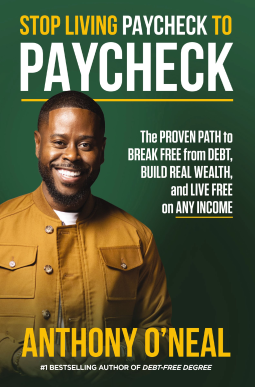
Stop Living Paycheck to Paycheck
The Proven Path to Break Free from Debt, Build Real Wealth, and Live Free on Any Income
Sign In or Register Now to see if this title is available for request.
Buy on BN.com Buy on Bookshop.orgSend NetGalley books directly to your Kindle or Kindle app
1
To read on a Kindle or Kindle app, please add kindle@netgalley.com as an approved email address to receive files in your Amazon account. Click here for step-by-step instructions.
2
Also find your Kindle email address within your Amazon account, and enter it here.
Pub Date Aug 25 2026 | Archive Date Not set
Nelson Books | Thomas Nelson
Talking about this book? Use #StopLivingPaychecktoPaycheck #NetGalley. More hashtag tips!
Description
A Better Way to Live Is Within Reach
Number one national bestselling author and trusted financial expert Anthony O'Neal provides the practical tools and everyday habits needed to build margin even if you're starting from zero. Drawing from his own story and years of coaching thousands toward financial freedom, Anthony shows you how to create real breathing room and finally take control of your money. Through simple, proven steps, you'll learn how to:
- Stabilize your finances and cast a vision for the goals that will guide you forward
- Eliminate all consumer debt and regain control of your spending
- Save three to six months of take-home pay and create habits that protect your progress
- Invest with confidence so your money starts working harder than you do
- Pay off your home, lock in your family's legacy, and start building wealth that blesses the people you love most
If you're tired of the stress and exhaustion of barely getting by, this book offers a proven roadmap to break the cycle for good. You don't need more shame. You need a plan and someone to walk with you while you take the first step. This is your fresh start.
Available Editions
| EDITION | Other Format |
| ISBN | 9781400251193 |
| PRICE | $29.99 (USD) |
| PAGES | 240 |
Links
Available on NetGalley
Available to Buy
Buy on BN.com Buy on Bookshop.orgAverage rating from 7 members
Featured Reviews
 Bella M, Reviewer
This book is solid and a good reference for anyone who is interested in building wealth. There were a lot of important tips regarding saving money.
 Demetris P, Reviewer
No One Puts a Legacy Binder on a Magazine Cover
Anthony O’Neal’s “Stop Living Paycheck to Paycheck” finds its quiet strength in the least glamorous tools: budgets, meetings, documents, and truth.
By Demetris Papadimitropoulos | July 18th, 2026
Debt is not the most unsettling object in Anthony O’Neal’s “Stop Living Paycheck to Paycheck.” The most unsettling object is the table. More precisely, it is the kitchen table where bills gather like weather carrying postage, where a credit-card balance grows by $500 in a month, where student loans and car payments and hospital statements sit beside a sandwich, and where a pregnancy test lands on top of the stack as both blessing and alarm. The book is sharpest when it knows that financial crisis is not only numerical. It is domestic. It has a room, a chair, a silence, a spouse trying not to cry.
Early in the book, O’Neal gives us his own version of that room. At twenty or twenty-one, he coasts into a gas station on fumes, calls the bank, and learns he has $6.32 to his name. He knows the station will initially authorize only one dollar, so he fills the tank and leaves tomorrow’s overdraft fee to his future embarrassed self. Then he buys two McDonald’s double cheeseburgers and two sweet teas, cuts the burgers in half, dilutes the tea with water, and stretches the meal over two days. The scene works because it does not ask for decorative pity. It catches the instant when what has been called normal is exposed as a trap with a receipt.
Much of “Stop Living Paycheck to Paycheck” grows from that humiliating arithmetic. O’Neal, a microphone-trained Christian financial coach, lays out what he calls the “Escape Plan,” meant to get the next paycheck off the household’s oxygen line. Its five phases – lay the foundation, clear the ground, build the framework, scale the structure, cement the legacy – keep the building metaphor in view with the steadiness of a contractor who brought extra labels. The budget is not a worksheet here; it is a foundation pour. There is debris to clear, beams to raise, a roof to place, and descendants who may one day need to find the paperwork.
Even here, the kindness is practical: the plan can be used while anxious. Write a Financial Vision. Give every dollar a mission through a monthly budget. Save one month of net pay and get basic protections in place. Attack consumer debt with the Debt Snowball. Cut expenses, raise income, build three to six months of emergency savings, create financial rhythms, buy a home carefully, invest, give, prepare an estate plan, and hold family wealth meetings. Leave behind documents and words that loved ones can use. O’Neal would rather hand over a checklist than admire the fog. He tells the reader where to put the next foot, then insists the other foot will have its turn.
The tools come with fingerprints from half the personal-finance shelf. Anyone who has spent time with “The Total Money Makeover” by Dave Ramsey, “You Need a Budget” by Jesse Mecham, or “The 21-Day Financial Fast” by Michelle Singletary will recognize the route: assign money before it disappears, avoid consumer debt, build emergency savings, invest steadily, treat generosity as a discipline, and stop confusing visible consumption with wealth. O’Neal does not invent the hammer. He tells the family where to keep it.
Richer than the budget mechanics is the book’s insistence that money be spoken. It wants balances, goals, bills, passwords, giving, and documents brought out of fog and into language: the written vision, the monthly money meeting, the family wealth meeting, the Legacy Binder, the Legacy Letter. Again and again, O’Neal takes private dread and gives it a repeatable family practice. Shame becomes a meeting. Drift becomes a plan. Grief becomes a folder someone can find. Families do not only lose wealth because they spend too much. They also lose it because no one said the thing clearly enough, early enough, often enough.
In the recurring story of John and Jasmine Henderson, a fictional composite couple, O’Neal gives his method a marriage, an apartment, a baby, and a bill stack. They begin in a small apartment south of Atlanta, pressed by rent, loans, car payments, hospital bills, a swelling credit-card balance, and the news of a child. Jasmine had imagined a house and a yard by the time she had children; John can only see numbers refusing to behave. The Hendersons are not deep characters. They are a working model of what the plan is supposed to change. The reader watches fear become budget, budget become debt payoff, debt payoff become saving, and saving become a family language. Their arc is deliberately uncomplicated; a handrail does not become nobler by twisting.
Prose is where the book’s gifts and limits are easiest to see. The sentences know how to coach; they do not know how to shimmer. O’Neal writes in short-to-medium bursts, with the rhythm of a stage-tested motivator who has learned that the anxious reader cannot use a paragraph that takes scenic routes. He anticipates objections, answers them, underlines the answer, and hands over a step. His diction blends finance and faith: net worth, Roth IRA, mortgage, high-yield savings, tithing, stewardship, blessing, bondage, legacy. Casual phrases – “Boom,” “swole,” “no flex,” “let’s get practical” – keep the voice within arm’s reach. The result is not literary texture so much as instruction with sneakers on.
At its best, that voice is bright enough to use. Its strongest scenes are built from things under pressure: the half-burgers, the diluted tea, the Bentley that makes a restaurant worker suddenly interested in O’Neal’s wisdom, the $64,000 home down payment, the family wealth meeting with a whiteboard and children learning the numbers. The Bentley scene is especially sharp because it compresses the book’s critique of borrowed shine into one small social comedy. The young man does not come to O’Neal; he comes to the car. Culture has trained him to spot wealth by shine, which is precisely how people end up financing shine instead of building wealth.
Part of O’Neal’s authority comes from refusing to let shame become identity. He has a keen ear for the reader who is not helped by another lecture about latte money, as though humiliation becomes more affordable when served hot. His language is shame-literate in its declared posture: you do not need more shame; you need a plan. That distinction matters. The book is full of commands, but its commands usually arrive with a hand extended. It says, in many variations: yes, this is serious; yes, you have made decisions; yes, the math may be ugly; no, you are not uniquely doomed; start here.
And yet the same certainty that gives the book its motivational charge also asks the beams to hold too much. The subtitle’s promise to help readers live free “on any income” asks more of the method than any method can reliably bear. O’Neal acknowledges medical bills, systemic racism, mental health struggles, natural disasters, layoffs, and corporate greed. He is not blind to forces outside individual control. But the book’s engine keeps returning, with the neatness of a scheduled withdrawal, to choice, discipline, mindset, and system-following. For readers with some income stability, some margin to create, and some household bandwidth, the advice can be bracing. For others, whose rent, medication, childcare, debt, and groceries have already divided the paycheck before the paycheck arrives, “on any income” may sound less like hope than a slogan that got waved through security.
Debt, for O’Neal, is corrosive because it costs more than money. It costs choice, peace, future movement, and family possibility. That argument persuades when he describes consumer debt as bondage, or when he punctures the worship of the credit score as if a high score were itself a moral halo. He is also right that much of American financial life is organized around performance: the car, the watch, the kitchen, the vacation, the little theater of being fine. Still, debt is not always tidy enough to serve as a moral lesson. It may be a foolish restaurant charge. It may also be dental surgery, elder care, a lost job, a coerced move, a spouse’s illness, or the price of having the wrong emergency in the wrong month.
If the prose sometimes repeats itself into carpeting, the phase design earns its keep. The five-part frame turns advice into construction. “Lay the Foundation” turns fantasy into written vision and assigns money before it leaks away. “Clear the Ground” makes debt the obstruction that must be removed before the house can rise. “Build the Framework” moves from debt attack into savings and rhythm. “Scale the Structure” turns survival into investing and giving. “Cement the Legacy” shifts from personal discipline to family transmission. The materials are familiar, but the house stands.
More than any debt-payoff chapter, the book’s late attention to inheritance shows what it can do. The family wealth meeting, Legacy Binder, and Legacy Letter are not glamorous tools. No one will put a Legacy Binder on the cover of a luxury magazine, though perhaps someone should, just to watch the handbags panic. Yet these sections are where O’Neal becomes most useful. He knows that “legacy” can become a gauzy word, all glow and no instructions. Here it means accounts listed, insurance named, funeral wishes recorded, estate documents findable, children taught, values spoken. It means not leaving your loved ones a scavenger hunt while they are grieving.
In these chapters, money becomes care with tabs. Family wealth is not only what accumulates; it is what gets explained. What good is a plan no one knows? O’Neal’s Christian frame matters here. His account of wealth is not simply get-rich practicality; it is stewardship, obedience, tithing, blessing, and being “blessed to be a blessing.” Secular readers may resist the theological premises, especially in the chapter that calls giving the first investment, but the book does not pretend wealth is morally neutral. Wealth, here, is not allowed to end at the mirror.
The ending quietly corrects the yacht. O’Neal invokes his father’s volunteer work as a hospice chaplain for veterans, presenting financial freedom as the ability to choose meaningful service rather than the freedom to become decorative. Then the final pages return to John and Jasmine decades later. They are work-optional, with a home near Atlanta, a cabin outside Colorado Springs, grandchildren, and the ability to choose between visiting family in Florida or flying to Paris. Paris is the shiny lure, and a pleasant lure it is. But the emotional center is Jasmine remembering the old kitchen table where the bills once gathered. That memory does the work: small faithfulness, repeated long enough, can become a life.
Repetition is both the book’s handrail and its wallpaper. Freedom, bondage, vision, financial house, plan, legacy, generosity – the refrains return until the reader could probably recite them while opening a high-yield savings account. For an overwhelmed beginner, this may be a mercy. Repetition is how a frightened mind learns where the exits are. For a reader already conversant with personal finance, it may feel heavy, as if every room in the financial house has been labeled twice and laminated. The same is true of the coach’s cadence: it gives momentum, but it can also hustle ambiguity out of the room before ambiguity has finished its sentence.
One should not scold a practical book for being usable. The question is whether its usefulness remains honest about scale. On that measure, “Stop Living Paycheck to Paycheck” earns respect and caution in nearly equal measure. It is strongest when the advice is family-sized: have the meeting, write the budget, save the buffer, attack the balance, stop performing wealth, teach the children, prepare the documents. It is weakest when the method’s confidence swells toward universality. Life has a discourteous habit of refusing phase order. The water heater does not wait for Phase 3. The hospital bill does not consult the monthly money vision. The landlord, that poet of escalation, rarely cares about your Financial Vision.
Paycheck-to-paycheck life, credit-card dependency, delayed homeownership, and racial wealth concerns all sit naturally behind the book. O’Neal raises some of these pressures directly, including the racial wealth gap, and his emphasis on homeownership, investing, family meetings, and generational wealth is partly an answer to that anxiety. But “Stop Living Paycheck to Paycheck” does not go to Congress; it goes to the kitchen. Its remedies are intimate: table, app, account, calendar, binder, will, tithe, meeting. That narrowness is both a limit and a source of force. It cannot repair the national arithmetic, but it can make one family less mysterious to itself.
Of the closest shelf-neighbors, “The Total Money Makeover” by Dave Ramsey is the one the book can neither avoid nor simply inhabit. O’Neal shares the anti-debt ladder, the behavioral logic of the Debt Snowball, and the impatience with a credit culture that confuses borrowing capacity with health. But his register is warmer, more openly concerned with Black wealth context, and more interested in the family meeting than the victory scream. “You Need a Budget” by Jesse Mecham is another useful neighbor, especially in the idea that every dollar needs a job; O’Neal’s “Monthly Money Vision” translates that principle into his own faith-and-household vocabulary. The tools are borrowed; the table arrangement is his.
Usefulness is the book’s art, if art is the word: handrail, table, folder, calendar. No one will embroider these sentences on a pillow, and if they do, one hopes they budgeted for thread. But some readers may remember the book when they finally hold a monthly money meeting without dread, stop hoping the card will clear by divine intervention and open the app instead, ask their parents where the documents are, or tell their children what the family gives and why. That is not a small form of usefulness. A book can be blunt and still be a door.
Looked at by its own promise, “Stop Living Paycheck to Paycheck” lands at 74/100, which translates by the stated rubric to 3/5 stars. The number fits a book whose rooms are sturdier than its claims: clear sequence, humane coaching, strong late chapters on inheritance, but also familiar advice, repeated refrains, and a subtitle larger than some households can survive. It is not a great money book. It is a good book about what money sounds like when a household finally starts telling the truth.
O’Neal’s smartest reversal is that the yacht is not the book’s best image of freedom. The yacht is pleasant, but brightness is not the same as truth. Luxury can still be a performance if the room behind it is full of secrets. What lasts is less cinematic: a table revisited, a budget spoken aloud, a document waiting where it should be, an adult child who knows not only what was saved but what it was for.
So the quieter image should have the last word: a table no longer crowded by secrecy, a family sitting down before the panic starts, a folder waiting where someone can find it, a child learning that wealth is not the glittering thing in the driveway but the unpanicked room where people can speak plainly about tomorrow.
 Taryn S, Reviewer
This was a helpful read for me not really knowing where to start to improve my financial situation. At nearly 50, it is a stressful subject as it feels hopeless sometimes. This was a real world approach with advice coming from someone who wants to help others stop struggling.
 Reviewer 1317817
I’ve been a fan of Dave Ramsey and his team for years, and this book was a fantastic addition. It’s packed with knowledge all in one place and offers easy-to-follow instructions to help you live your best life.
Thank you to NetGalley and the publisher
denise w, Reviewer
Solid advice on saving money. I have read Dave Ramsey and would add this to the same shelf. Both in their right are useful and helpful. Thank you to O'Neal for another tool to help get ahead in this world.
 Geeah T, Reviewer
Thank you NetGalley for this ARC!
As an avid budgeter I love reading new budgeting content. I've known about Anthony from Dave Ramsey but haven't gotten a chance to dive into his way of budgeting. As a budgeter though, I've read and listened to many, many different ways to get your money right and it's hard to give out new information. This book is definitely marketed towards beginners who need guidance and African Americans. The tone and dialect of the book leans more towards a particular demographic. The details and instructions lean towards a newer budgeter. I would recommend.
Reviewer 2072637
I am somehow familiar with Anthony O'Neal from when he was on Ramsey's team. I enjoyed the book; it presents practical financial advice in a conversational way that is easy for regular folks to follow and apply. I appreciated the real life examples, the encouraging tone, and the push to develop real and healthy financial habits rather than quick fixes. I am not adept at religious concepts in business books, but they were a great integration into the book. Overall, I found the book a great tool for developing strategies for anyone looking to gain better financial control; at this point, I can't say this is a proven method to stop living paycheck to paycheck.
Readers who liked this book also liked:

We Are Bookish
Mystery & Thrillers, OwnVoices, Teens & YA

Ben Clanton; Katie Cook; Brittney Williams; Grace Ellis; Jordan Morris; Michael Northrop; Stephanie Cooke; Annie Nishida
Children's Fiction, Entertainment & Pop Culture, Parenting, Families, Relationships



Dave Ramsey
Business, Leadership, Finance, Christian, Nonfiction (Adult)

Toby Amidor, MS, RD, CDN
Cooking, Food & Wine, Health, Mind & Body, Nonfiction (Adult)

Céline Fitzmaurice
Biographies & Memoirs, Mystery & Thrillers, True Crime