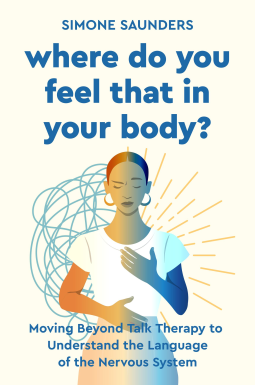
Where Do You Feel That in Your Body?
Moving Beyond Talk Therapy to Understand the Language of the Nervous System
This title was previously available on NetGalley and is now archived.
Send NetGalley books directly to your Kindle or Kindle app
1
To read on a Kindle or Kindle app, please add kindle@netgalley.com as an approved email address to receive files in your Amazon account. Click here for step-by-step instructions.
2
Also find your Kindle email address within your Amazon account, and enter it here.
Pub Date Aug 25 2026 | Archive Date Sep 1 2026
Grand Central Publishing | Balance
Description
Many of us assume that once we understand why we feel the way we do, things will finally change. Traditional talk therapy often equips us with the language and self-awareness we’ve been missing — yet so many of us find ourselves stuck. We can recognize the trigger, name the pattern, and explain the story, yet still feel unable to create tangible change in our day-to-day lives. So, where’s the disconnect? What’s missing?
Registered social worker and trauma therapist Simone Saunders believes the answer lies in crossing the threshold from the mind into the body—moving from self-awareness into a felt, embodied understanding. In Where Do You Feel That in Your Body, Simone guides you through a gentle and practical approach to noticing what emotions feel like in your body, understanding the protective patterns shaped by identity and past experiences, and recognizing how your nervous system responds to stress and disconnection. You’ll learn how to read your body’s signals with curiosity, and how to build the capacity to stay present with your emotions instead of disconnecting from them.
In recent years, the language of the body—posture, facial expressions, movements, and sensations—has become more widely recognized for the integral role it plays in shaping and maintaining our survival patterns. Where Do You Feel That in Your Body shows you how to build a steady, supportive relationship with your nervous system that grows and shifts over time. You’ll understand how your body and mind communicate, how identity and culture shape your emotional responses, and how to gently shift the patterns that once helped you survive.
Available Editions
| EDITION | Other Format |
| ISBN | 9780306836459 |
| PRICE | $30.00 (USD) |
| PAGES | 304 |
Available on NetGalley
Available to Buy
Buy on BN.com Buy on Bookshop.orgAverage rating from 22 members
Featured Reviews
 Chelsea W, Reviewer
"Where Do You Feel That in Your Body?" by Simone Saunders is a complete game-changer for anyone looking to bridge the gap between mental health and physical sensation.
As a licensed therapist, Saunders has a gift for making complex somatic therapy concepts feel incredibly approachable and practical. The book is more than just a theory guide; it’s an interactive roadmap that helps you decode the "language" of your nervous system.
The exercises and prompts are what truly set this apart—they aren't just "fluff," but real, actionable tools to help you ground yourself when you're feeling overwhelmed or disconnected. I found the sections on identifying where we store specific emotions like anxiety and grief to be particularly eye-opening.
If you’ve ever felt like traditional talk therapy was missing a piece of the puzzle, this is it. It’s a compassionate, empowering, and essential read for anyone on a healing journey. Highly recommend!
 Mark K, Educator
Where Do You Feel That in Your Body? gets at something a lot of people quietly struggle with, which is knowing exactly why they react the way they do but still not being able to change it. The book explains that insight alone is not enough, because your body and nervous system are often running the show, especially in stressful moments . One of the biggest takeaways is learning to notice what is happening in your body in real time, like tight shoulders, a racing heart, or going numb, and using those signals as information instead of ignoring them. It breaks down how your nervous system shifts into fight, flight, freeze, or people pleasing, and how recognizing those patterns can help you pause instead of reacting automatically . The book also introduces the idea of a “window of tolerance,” meaning the zone where you can feel emotions without getting overwhelmed or shutting down, and shows how to slowly build your way back into that space . It gives simple ways to reconnect with yourself, like paying attention to sensations, grounding through your senses, and getting curious about your reactions instead of judging them. What makes it stand out is how practical it feels, especially if you have ever felt stuck in the same patterns even after doing a lot of thinking and talking. Overall, it is a really useful read that helps you actually work with your body instead of fighting it, and I would definitely recommend it.
 Kelly P, Reviewer
This felt like the extension of my weekly therapy sessions I so needed! The content is informative and presented in an easy-to-understand way. I found myself devouring the information and paying attention to what Saunders was explaining. I only have recently been aware of where I feel emotions in my body, so this was the perfect book for me! Thanks to NetGalley for the ARC.
 Zelda H, Reviewer
A stunningly clear and practical guide to understanding the connection between our emotions and physical sensations. Simone Saunders makes complex somatic concepts feel approachable and actionable. This is a must-read for anyone looking to deepen their mind-body connection and navigate their healing journey with more compassion.
 Reviewer 805047
Where Do You Feel That in Your Body is for anyone who’s ever been like, “I know why I’m like this… so why am I still stuck?”
Simone Saunders (a Black Caribbean Canadian therapist- I love that context matters here) does such a good job breaking down the connection between the mind, body, and nervous system without making it feel overwhelming or clinical. It’s super accessible but still rooted in real therapeutic frameworks.
She talks about the window of tolerance in an expansive way, too. Not just “am I in or out of it?” but… how big is my window actually, based on what I’ve lived through? That shift alone is unique and important.
And I really appreciated her neurodiversity-affirming approach. As someone with ADHD, she names how differently we all experience our bodies depending on ability, identity, culture, race—all of it. That kind of nuance? We need more of that in this space.
This is one of those books that will feel affirming if you’re a therapist but also really supportive if you’re just trying to understand yourself better. It helps you move from just thinking about your healing to actually feeling it. It helps you reconnect to your body as a dear friend who holds important insider information.
A soft, grounding guide for reconnecting with yourself in a real way.
Readers who liked this book also liked:


Amber Emily Smith
Biographies & Memoirs, Christian, Religion & Spirituality







Kate Sustersic Gawlik; Bernadette Mazurek Melnyk
Health, Mind & Body, Parenting, Families, Relationships, Self-Help

Bernadette Murphy
Biographies & Memoirs, Nonfiction (Adult), Parenting, Families, Relationships


Dawn Babb Prochovnic
Children's Fiction, Parenting, Families, Relationships